
As of the 16th of October 2026, Bitget, Bybit, and Remitano had Naira offers, while OKX and KuCoin showed none. However, Binance, Quidax, and LocalBitcoins are no longer available for Naira P2P. On any platform, release your crypto only after the full payment shows in your own bank app. In February 2024, Binance pulled naira from its P2P platform, while Quidax also terminated P2P services on 23rd of January, 2026.
With respect to your time of reading this piece, the statements above are dated observations, not a guarantee of today’s availability.
Note: Swapto publishes this guide, and Swapto is one of the options in it. We judged every option, Swapto included, on the same criteria, listed under How we compared. Swapto is not a P2P exchange: you sell to Swapto directly, so it appears near the end as an alternative to P2P. Feel free to see more apps that convert crypto to cash.
Last checked:
What Is a P2P Crypto Exchange, and How Does It Work in Nigeria?
Peer-to-peer crypto exchange is a platform that links those who are looking to buy cryptocurrencies to those who want to sell cryptocurrencies. Rather than going to the platform yourself, you’re merged to trade with another user. Assume that you have USDT or Bitcoin and you need naira in your account, you can go to find someone willing to sell you the naira with an accepted payment method.
Basically, the platform will keep the seller’s cryptos in escrow until the buyer pays, and the seller confirms receipt of payment. This will make it harder for either party to “take” the other party’s asset without a sale being finalized. OKX says the escrow holds the seller’s crypto until payment is confirmed. KuCoin also states that the seller’s assets are escrowed for the transaction. But escrow doesn’t mean your bank transfer will arrive or keep you safe from all forms of fraud.
Here is how a typical P2P sale works:
- Choose a buyer: The first thing to do is select an offer that matches your coin, amount and preferred payment method. Review the buyer’s completion history, verification status and trading terms.
- Place the order: When you place your order, the platform locks the cryptocurrency covered by the order while the transaction is in progress.
- Receive the naira: The buyer sends your payment through the agreed bank or payment service. The payment transfer happens outside the crypto platform, so you must carefully verify that you receive payment in your bank account.
- Confirm and release: After confirming the entry of funds into your bank account, check the sender’s identity, then proceed to release the crypto only after these checks are completed.
For example, someone searching for a P2P Bitcoin exchange in Nigeria may find a seller willing to accept a bank transfer for Bitcoin. The same general process applies when selling USDT, although supported coins, payment methods, and order conditions vary by platform.
If you prefer buying and selling through a traditional order rather than dealing with individual P2P advertisers, read our guide to see cryptocurrency exchanges in Nigeria.
Which P2P Crypto Exchanges Still Take Naira in October 2026?
The availability of a platform can change anytime without much notice to the public. A Naira trading page may be available on a platform with no offers available, this makes the existence of a page alone to be insufficient proof that you can complete a Naira trade.
How we compared
The comparisons are based on platform status observations on 16 October 2026, official announcements and the safety information published by each exchange. Platforms are not given any hierarchy. The primary check is whether NGN offers were visible.
There was no test trading for this guide and claims regarding measured transaction speed and/or successful payout time cannot be accurately declared.
The following status information is a snapshot in time. Readers are advised to check the NGN P2P page of the platforms for additional verification. Never assume that an older observation is a confirmation of an available observation.
Naira offers seen on 16 October 2026
Bitget
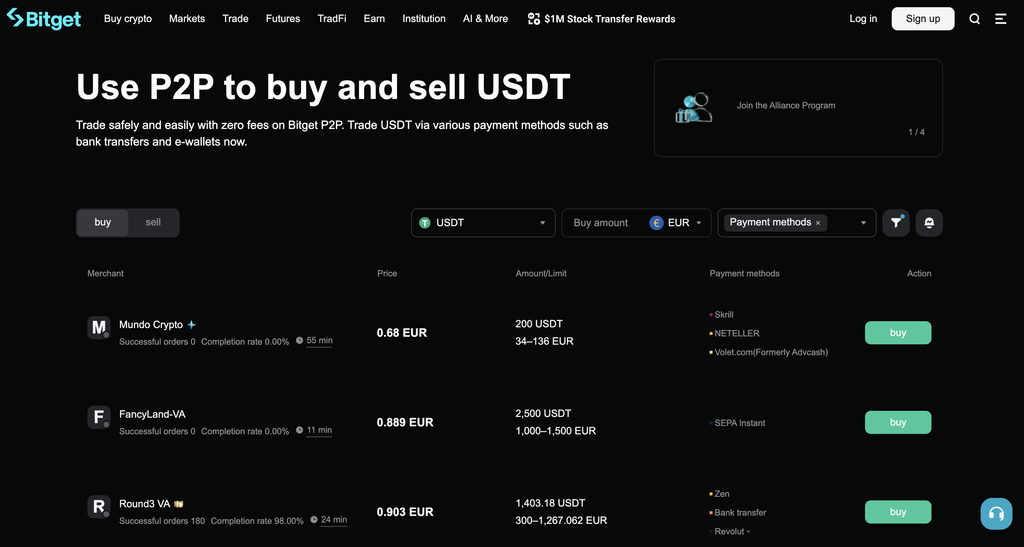
Bitget’s P2P marketplace displayed naira offers to be available as of the 16th of October, 2026, primarily focusing on mainstream cryptocurrencies including USDT, USDC, BTC, ETH, and BGB, with bank transfer being the most popular payment method accepted by the merchants. If you’re new to the platform, you will need to meet the identity verification requirements for Nigerian users. Bitget’s P2P page says users can “trade safely and easily with zero fees on Bitget P2P”. To initiate an appeal after negotiations fail, navigate to your My Orders or Order Details page and click Submit Appeal. The same page says: “After placing the order, the coins will be held by Bitget P2P.” Bitget is not named in SEC Nigeria’s circulars list as of 23 October 2026.
Bybit
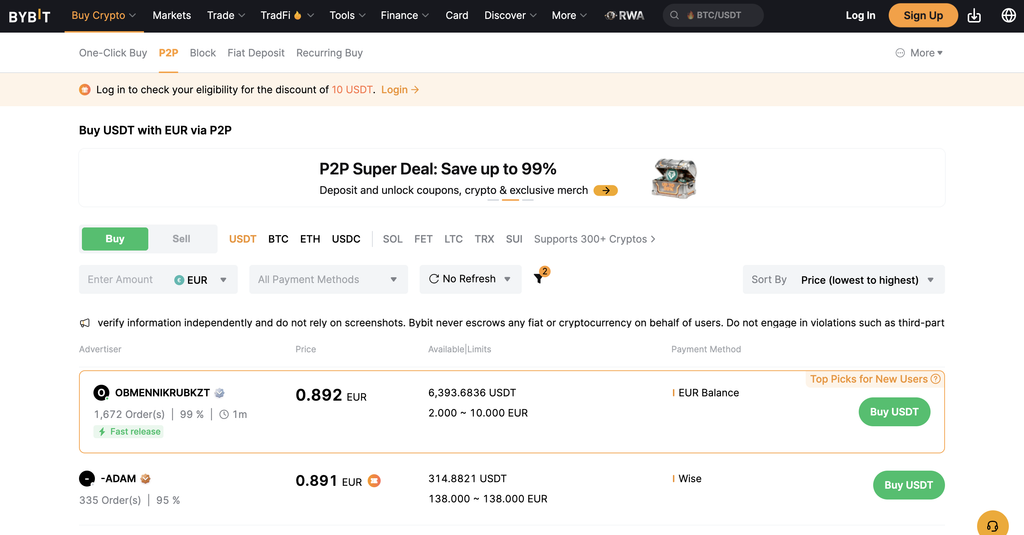
Bybit P2P supports a wide range of cryptocurrencies, including major assets like USDT, BTC, ETH and USDC. Buyers pay through an agreed payment method such as local bank transfer, mobile money, or e-wallets. Communicate strictly inside the Bybit P2P order chat box to keep a verifiable record, so that when a trade goes wrong, you can easily submit an Appeal/Dispute, by going to the active order and click Submit an Appeal (choose either Normal Track or Fast Track if eligible). Bybit is not named in SEC Nigeria’s circulars list as of 23 October 2026.
Bybit announced a modification that removed eight payment methods from 1 September 2026: Paga, Chipper Cash, Carbon Microfinance, Jaiz Bank, Stanbic IBTC Bank, Ecobank, Polaris Bank and Union Bank. These methods could no longer be used to create NGN advertisements or trade against them after the announced deadline. When you add a supported payment method, you can easily buy USDT on Bybit.
Remitano
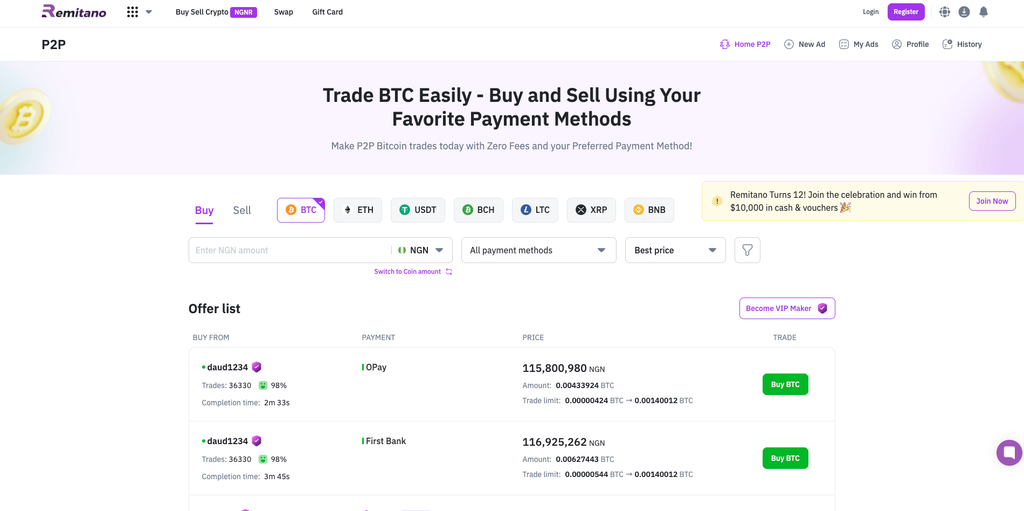
Remitano P2P supports major cryptocurrencies and stablecoins, most commonly USDT, Bitcoin (BTC), Ethereum (ETH), and other popular digital assets. Direct bank transfer is widely accepted for payment. According to posts on Remitano’s forum, its platform fee for local currency is ₦0 (except for standard bank transfer charges or statutory levies), users who publish ads to buy or sell crypto on the P2P market are charged 1% fee by the platform, and users who pick an existing ad posted by someone else are charged 0% fee. In the case where things go wrong, initiate a dispute and submit clear evidence (such as a full-screen screenshot of your official bank account statement/transaction history) to the live support chat with your trade reference number. Remitano is not named in SEC Nigeria’s circulars list as of 23 October 2026.
Observations taken on the 16th of October 2026 showed that Nigerian Naira (NGN) is actively available on Remitano for peer-to-peer (P2P) trading, internal fiat wallets, and coin swaps, with bank transfer to popular Nigerian banks appearing as the most engaged payment method.
No Naira offers seen on 16 October 2026
KuCoin
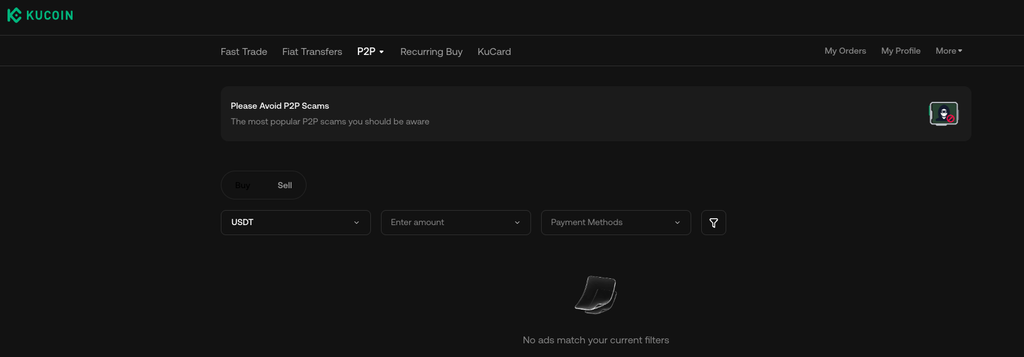
No matching ads were found on the USDT/NGN page on 16 October 2026. The page showed the message “No ads match your current filters”. This is a significant difference. KuCoin was previously available for naira P2P trading but an old announcement does not mean that the appropriate NGN offer is still available today. In case there are no ads when you check later, don’t rely on the platform for getting naira on that day. The same page says: “After creating a buy order, the seller’s assets for this transaction will be escrowed by KuCoin platform.” KuCoin Nigeria Limited was cleared for SEC Nigeria’s Accelerated Regulatory Incubation Programme (ARIP) in July 2026, and the SEC says an Approval-in-Principle “is not a final licence”.
OKX
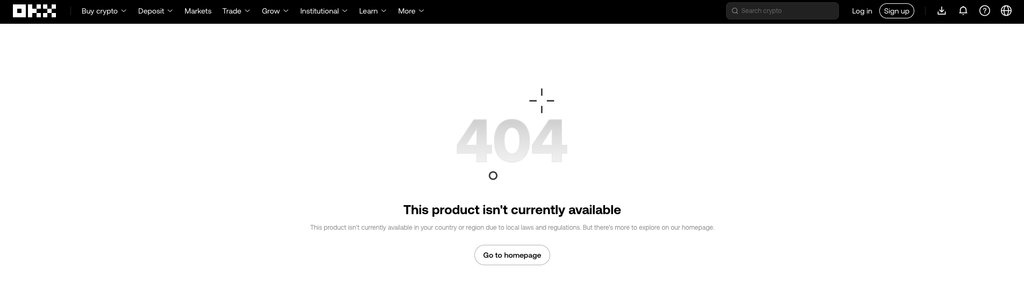
OKX’s NGN P2P page showed no naira offers when checked in October 2026. A published guide by OKX says that the P2P operates through an escrow where the platform holds the seller’s crypto during an order and recommends trading with verified merchants where possible.
OKX also provides guidance by advising users to confirm their own bank for payment, decline third-party payment when it is not permitted by the applicable rules and submit an appeal in the time limit indicated.
No longer available for naira P2P
Binance: Binance suspended all NGN P2P trading pairs. It also suspended other Naira operations like NGN deposits and withdrawals in March 2024.
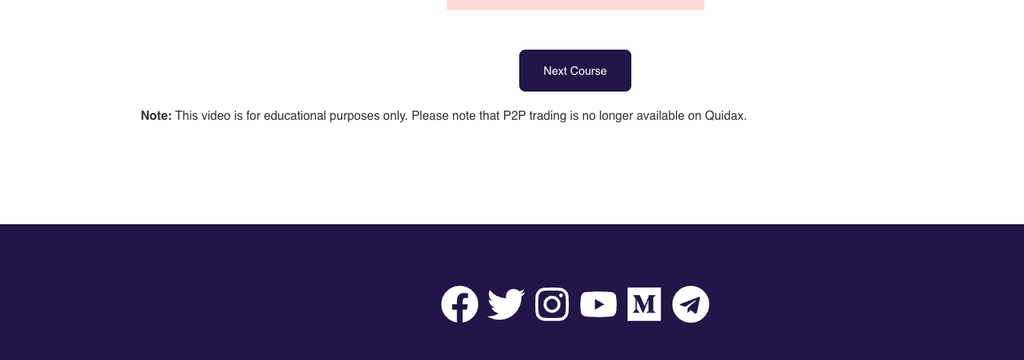
Quidax: Quidax officially discontinued its peer-to-peer (P2P) marketplace on January 23, 2026, which is only after a few months of operation. Quidax says it made the change “to focus on what matters most to our customers”.
LocalBitcoins: LocalBitcoins is no longer available. The platform suspended new registrations on 9 February 2023 and suspended trading on 16 February 2023.
What Has Changed for Nigerian P2P Traders Since 2024?
The main changes are observed in how users can no longer trade directly against the naira on some platforms, followed by restrictions in payment methods on the remaining platforms. Below are few instances:
- 28 February 2024: On 28 February 2024, Binance officially delisted all NGN pairs from the P2P platform before proceeding to discontinue and withdraw all Nigerian Naira services in March, 2024.
- 21 September 2025: On 21 September 2025, Quidax announced the launch of P2P trading. This service didn’t go on for long before it was later disabled on January 23, 2026.
- 1 September 2026: Bybit removed 8 Nigerian payment methods from the P2P service on the 1st of September, 2026. This affects users of Paga, Chipper Cash, Carbon Microfinance, Jaiz Bank, Stanbic IBTC Bank, Ecobank, Polaris Bank or Union Bank, as these are no longer viable for trading against the NGN.
From the changes above, we can see how important it is to keep an eye on the market. The platform that earlier used to offer naira may not have such offers available today, or they might have removed the payment method you’re familiar with.
Use only the balance necessary for the trades you wish to make in order to get your money out of the system quickly. Also, ensure you have an alternative option in case your preferred platform ceases operations.
How Do P2P Scams Work in Nigeria, and How Can You Avoid Them?
A P2P (Peer-to-Peer) is a service that brings two users together to meet an urgent trading need. Even if the platform stores the digital asset in an escrow, there will always be a loophole for fraud in a P2P transaction that involves a payment between two unfamiliar individuals. According to KuCoin’s guideline, here are some common types of scams:
- Fake proof of payment: Here, the buyer sends an edited screenshot of a receipt or other claims to have paid when no money has arrived in your bank.
- SMS alert: This is also common in a P2P market, where the buyer imitates a bank notification to convince the seller that a payment was successfully made.
- Chargeback scam: This involves the buyer sending real payments to the seller, then reporting the payment as unauthorised after the seller has released the crypto. This prompts the buyer’s bank to reverse the payment. Whereas the crypto sent can’t be reversed.
- Impersonation scams: The user is convinced to give information or release funds by pretending to be a platform employee, verified merchant or support agent.
- Triangle scam: Two transactions are manipulated so that a seller receives less money than expected or releases crypto against the wrong payment.
- Man in the middle: A fraudster imitates a reputable merchant, and supplies misleading payment or account details.
KuCoin explains these risks in its official P2P scam guide. OKX also publishes scam prevention rules, stating that you can appeal for an order within 72 hours after being scammed. Before releasing any cryptocurrency, you should follow these precautions:
- Always double-check ads and links on the project’s real official account.
- Check to confirm receipt of payment in your own banking app. Avoid using the buyer’s screenshot, SMS, email or word of the buyer. Check if the quantity intended to sell matches the amount received.
- Keep conversations in the platform’s chat. Do not shift the deal to another platform (like WhatsApp or Telegram) that won’t be accessible to track conversations from.
- Match sender’s identity. Make sure the name on the payment account is consistent with the identity provided buyer and payment rules of the platform. Avoid accepting payment from a third party.
- Read the conditions of the order. Establish the quantity, payment terms and due date before making a trade.
- Take advantage of an appeal if necessary. In the event that the payment is either missing or incomplete, or if the payment seems suspicious, don’t release the crypto. Instead send evidence via official order page in connection with platform support.
- Secure your account by using a strong password and 2-factor authentication. Don’t give one-time passwords, recovery codes or account details to a purported support agent.
Warning: Never release crypto because of a screenshot, an SMS or an email. Open your own bank app to confirm. For more practical advice, read our guide on how to avoid crypto scams in Nigeria.
Is P2P Crypto Trading Legal in Nigeria?
The crypto regulations in Nigeria have undergone various modifications and changes over the years. The CBN lifted its restriction on banks serving crypto businesses in December 2023, this was followed with operational guidelines for the bank accounts of the Virtual Assets Service Providers in December, 2023. The guidelines do not allow banks to hold, trade or transact in virtual currencies of their own account. However, the policy doesn’t imply that any crypto business automatically gained regulatory approval.
The Investments and Securities Act 2025 provides for the registration and regulation of virtual and digital asset exchanges and virtual asset service providers by the SEC under its provisions including section 3(3). The SEC also has the Accelerated Regulatory Incubation Programme (ARIP), which was designed to hasten the on-boarding of digital assets and other investments service providers.
KuCoin Nigeria Limited and GIGX Technologies were admitted to the programme in July 2026 by SEC. The Commission also mentioned that an ‘Approval-in-Principle’ is not a final licence, such information is very important when checking claims about a platform’s regulatory status.
Additionally, tax implications also matter when discussing the legalities of crypto trading in Nigeria in 2026. From 1 January 2026, profits from selling crypto are taxable under the Nigeria Tax Act 2025 at personal income tax rates. Keep a record of what you bought, when, and for how much. This is general information, not tax advice. Treatment of any specific transaction will vary based on the facts and the rules. See PwC’s summary of the tax changes in Nigeria for further information.
Note: This section is based on general information, not legal or tax advice. Consult a qualified Nigerian legal or tax professional for expert insight.
Should You Use P2P or Sell Direct?
The reason why P2P can provide a better rate is the competition involved; buyers compete for the sellers’ crypto. If you have the time to shop around to compare prices, and are also comfortable with the rules of the platform regarding safety, then such a price difference may be worth it. Some platforms may claim to charge no p2p trading fees, but it is best to verify from the breakdown that is shown upfront before instead of assuming that all transactions are free.
The choice to pick between P2P or selling directly depends on four considerations: scam risk, time, total cost and the support available when things go south.
- Scam risk: P2P sellers must take notes of different scams and precautions mentioned earlier in this article, while adhering to the dispute process. A well-designed escrow system can’t eliminate all risk and loopholes for fraud.
- Time: It can be time-consuming to get an appropriate buyer at the price you intend to sell, to get paid and to confirm the payment. Disagreements make the time longer. A direct-sell service makes your experience simpler because you won’t have to deal with any buyer.
- Total cost: compare the final amount in naira, not the advertised rate or charges. Observe any stated trading fees, buying or selling charges, then get the differences to know how much you actually receive. While P2P can offer a slightly higher rate, it needs to be considered if the time, effort and risk involved is worth taking.
- Who you can complain to: An appeal can be made through the order process on a P2P platform, but with a direct-sell service, you deal directly with the service support team. Both routes may not guarantee immediate resolution of your problem, but talking directly to a support team gives your problem a better chance of solution.
P2P may suit someone who wants to compare offers, has time to wait and is comfortable trading with verified buyers. Direct selling may be easier for someone who prefers a quoted naira amount and does not want to waste time negotiating with other traders.
If you want to explore other ways to cash out, see our guide on converting crypto to cash in Nigeria. Freelancers receiving international payments can also read our guide on how to receive crypto from foreign clients, while Nigerians abroad can explore ways to send money home using crypto.
An Alternative to P2P: How Does Swapto Compare on the Same Checks?
Swapto (previously known as Dtunes) belongs to the category of Over-The-Counter (OTC) platforms. It is not a peer to peer exchange. Here, you trade your cryptocurrency to Swapto rather than get an offer from another user. The transaction doesn’t involve a P2P escrow arrangement between you and a buyer. Instead, you send the coin to your Swapto wallet, sell it, and withdraw the naira to your Nigerian bank account.
Swapto provides support for trading BTC, USDT on TRC-20, ERC-20 and BEP-20, ETH, TRX, USDC, BNB and LTC. Auto-sell is optional: when enabled, a deposit converts at the live rate once credited; when disabled, the crypto remains in your wallet until you sell. Another interesting feature with Swapto is that you get to see your Naira amount before you confirm. You verify your identity with your BVN in the app, and network fees charged by your sending wallet are separate. Moreover, the entire payout process takes between 5 to 10 minutes after selling.
- Limited number of coins
- Does not allow price negotiation
- Not a P2P marketplace
If you prefer to sell directly through OTC, you can see the naira rates before selling on Swapto today. To determine if it meets your needs, you can also read Is Swapto legit?
Frequently Asked Questions
What is the best P2P crypto exchange in Nigeria?
There is no overall best P2P exchange that suits everyone. The platforms in this guide were discussed without a ranking because no test trades or performance tests were conducted. Kindly proceed to check the individual platform’s official pages before deciding.
Does Binance P2P still support naira?
On 28 February 2024, Binance officially delisted all NGN pairs from the P2P platform before proceeding to discontinue and withdraw all Nigerian Naira services in March 2024.
Did Bybit stop naira P2P?
Bybit removed 8 Nigerian payment methods from the P2P service on the 1st of September, 2026. The announcement did not state that the entire NGN P2P market was ending.
Is P2P crypto trading legal in Nigeria?
Nigeria’s regulatory framework includes the Central Bank’s guidelines for bank accounts serving virtual asset service providers and the Investments and Securities Act 2025. However, not every platform has the same regulatory status. The SEC says an Approval-in-Principle under ARIP is not a final licence. Crypto profits may also be taxable. This is general information, not legal advice.
How do I avoid fake payment alerts on P2P?
Open your own bank app and confirm that the full payment has arrived before releasing crypto. Do not rely on screenshots, SMS messages or emails. Check the sender’s identity, refuse payments that violate the platform’s third-party payment rules, keep communication inside the platform and use the appeal process if something looks wrong.
What payment methods do P2P buyers in Nigeria use?
Bank transfer is one payment method that is popularly adopted, but the options available depend on the platform and the individual advertisement. Methods vary: Bybit removed selected NGN payment methods in September 2026. Check the current offer and ensure that the payment method used matches the order terms. Never accept an unexplained third-party payment.
How long does a P2P trade take in Nigeria?
There is no single reliable completion time for every P2P trade. It depends on finding a buyer, the buyer’s payment, your bank’s processing and whether a dispute arises.
Is Swapto a P2P exchange?
No. You sell to Swapto, and naira arrives 5 to 10 minutes after you sell. Swapto provides support for selling BTC, USDT (TRC-20, ERC-20 and BEP-20), ETH, TRX, USDC, BNB and LTC, while operating within Nigeria’s regulatory framework through a licensed partner.
Sell Crypto for Naira
Using P2P is considerable when you want to compare offers and negotiate the price, but it requires extra carefulness and the need to know the platform’s dispute procedures. For those who like the idea of dealing with a service provider instead of a particular buyer, direct selling may be considered.
There are several risks involved with these methods, so before selecting one, you should find out the amount you’re getting and whether the risks involved are worth taking. In case of a direct sale, you can see the naira amount on Swapto.
How this guide was made: Emmanuel Tijani wrote this guide and checked each platform’s status on the platform’s own pages on . Swapto publishes this guide.