
Not for naira. Binance ended its Nigerian naira (NGN) services between 28 February and 8 March 2024, including P2P trading, deposits, withdrawals and naira trading pairs. The public P2P page showed no visible offers when checked on 28 October 2026. Binance said Nigerians can keep using its other crypto services.
We didn’t find any Nigerian law that banned Binance outrightly. However, Nigeria’s Securities and Exchange Commission (SEC) said in 2023 that Binance Nigeria company was operating illegally, and Binance was charged in Nigerian courts in 2024.
Note: Swapto publishes this guide, and Swapto is one of the options in it. We judged every option, Swapto included, on the same criteria, listed under How we compared.
How we checked: On the 28th of October, 2026, we checked Binance’s P2P page with NGN selected, searched Binance’s announcement ending naira services, and checked the SEC’s circulars page. The public P2P page showed no NGN offers in the page snapshot.
What stopped working on Binance for Nigerians, and when?
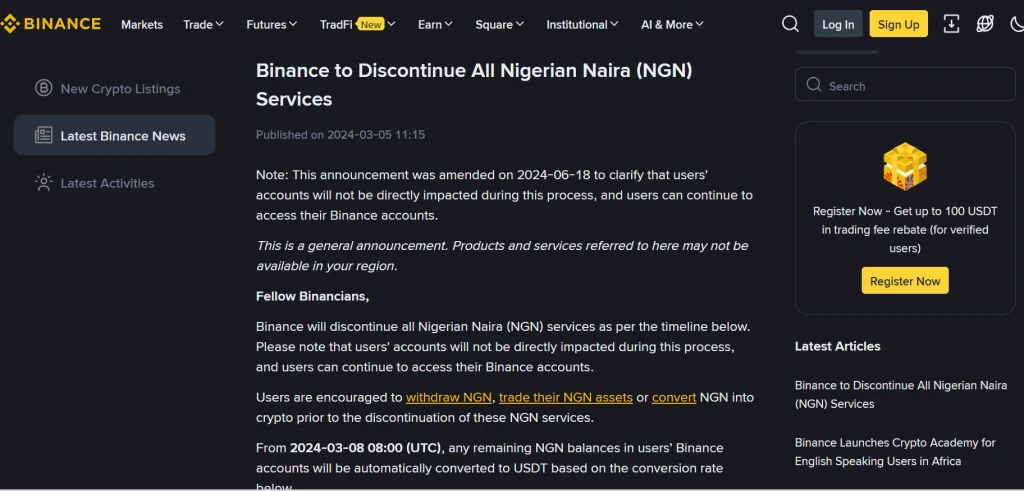
Binance’s notice indicated it was going to terminate all Nigerian Naira services. It announced specific dates and times for each change. The notice offered no specific reason for the decision, so it’s best to avoid guesses or speculation floating about the internet, and follow what Binance has said.
Here is the timeline:
- Late February 2024: Two senior Binance executives, Tigran Gambaryan and Nadeem Anjarwalla, flew to Abuja, Nigeria, for talks with government authorities. Instead of negotiations, they were detained by the Office of the National Security Adviser (ONSA).
- 28 February 2024: Binance P2P delisted all NGN trading pairs. This removed the naira from its peer-to-peer marketplace.
- 5 March 2024: Binance stopped accepting naira deposits.
- 7 March 2024: Binance delisted its existing NGN spot trading pairs, including BTC/NGN and USDT/NGN.
- 8 March 2024: Binance stopped supporting naira withdrawals.
- 8 March 2024: Binance began converting leftover naira balances in users’ Spot and Funding wallets to USDT at a stated rate of 1 USDT to ₦1,515.13. Binance said the conversion could take approximately 24 hours or longer.
An important clarification made by Binance is that its entire service is not shutting down because of the ending naira services. Binance said customers could continue using other Binance services and products for other available cryptocurrencies. The affected services include Naira deposits, Naira withdrawals, and NGN P2P only.
What we found in October 2026: As seen in the NGN P2P snapshot taken in October 2026, there was no visible offer on the page for the NGN currency. This shows the distinction between access to crypto services and the availability of a naira payment route.
What happened between Binance and Nigeria?
The detail is not as simple as what was announced regarding the Naira. It contains regulatory warnings, adjustments to banking guidelines, the arrest of two Binance executives, and the cessation of naira services and a number of court proceedings. The events below are chronologically arranged and allegations are separated from court decisions:
- October 2019: Binance introduced naira deposits with three trading pairs, according to reporting by Cointelegraph.
- March 2020: Binance added the naira to its P2P marketplace. According to cointelegraph, NGN was the first African fiat currency supported there.
- 5 February 2021: The Central Bank of Nigeria (CBN) issued a circular restricting banks from serving cryptocurrency businesses.
- 9 June 2023: The SEC published a circular stating that Binance Nigeria Limited was not registered by the Commission and that its operations in Nigeria were therefore illegal.
- 28 July 2023: The SEC issued a further warning against investing with Binance, repeating its position on the platform’s regulatory status.
- 22 December 2023: The CBN issued guidelines allowing banks to open accounts for virtual asset service providers under the stated conditions. The guidelines superseded the 2021 circular, although banks remained prohibited from holding, trading or transacting in virtual currencies on their own account.
- Late February 2024: Nigerian authorities detained Binance executives Tigran Gambaryan and Nadeem Anjarwalla.
- 28 February to 8 March 2024: Binance ended its naira services, including P2P trading, deposits, spot trading pairs and withdrawals.
- 22 March 2024: The Office of the National Security Adviser said Anjarwalla had escaped from lawful custody.
- 25 March 2024: Nairametrics reported that the Federal Inland Revenue Service (now the Nigeria Revenue Service) had filed tax evasion charges against Binance.
- 2024: The Economic and Financial Crimes Commission (EFCC) filed another case involving allegations of money laundering, operating a financial institution business without a licence and unauthorised foreign exchange dealing.
- 14 June 2024: The court discharged Gambaryan and Anjarwalla from the tax case after the prosecution amended the charge to name Binance as the sole defendant.
- 23 October 2024: The court discharged Gambaryan from the EFCC case on health grounds. The proceedings against Binance continued.
- November 2024: The EFCC filed an amended six-count charge against Binance Holdings Limited and Anjarwalla.
- February 2025: The Federal Inland Revenue Service’s separate civil suit seeking compensation for alleged economic losses and unpaid tax came before the court.
- April 2025: Court report covered further steps in the civil suit over the method of serving documents on Binance.
- March to July 2026: Reports said Binance and the government were exploring an out-of-court resolution of the tax evasion case. On 9 July 2026, the court adjourned the matter to 24 September 2026 for a settlement report or continuation of trial.
Is Binance banned in Nigeria?
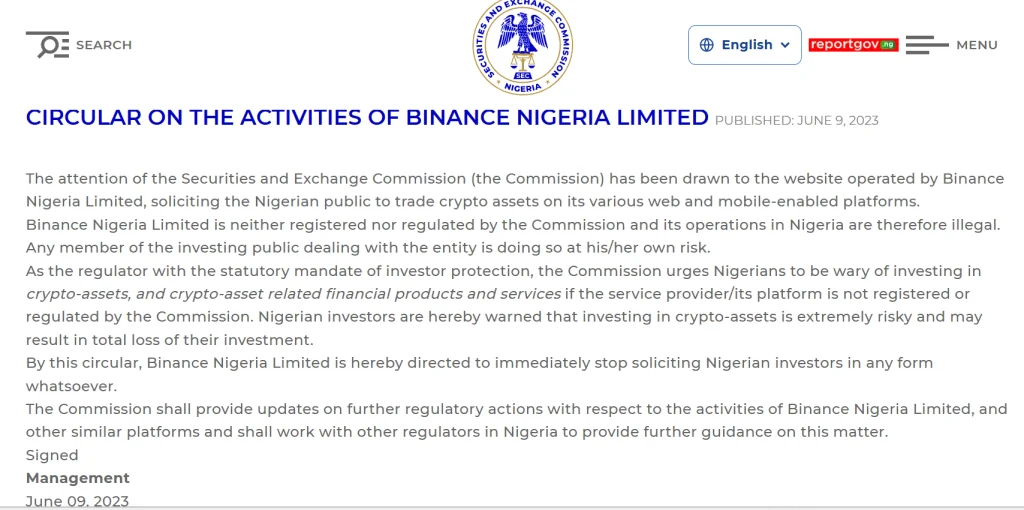
We found no Nigerian law or regulator order that bans Binance by name. What we found was an SEC’s warning about Binance, Binance’s personal decision to end Naira services, and the court cases charged against the company.
On the 29th of June 2023, The SEC mentioned that its operations in Nigeria were illegal because Binance Nigeria Limited was ‘neither registered nor regulated by the commission’. The commission repeated this warning on 28 July 2023.
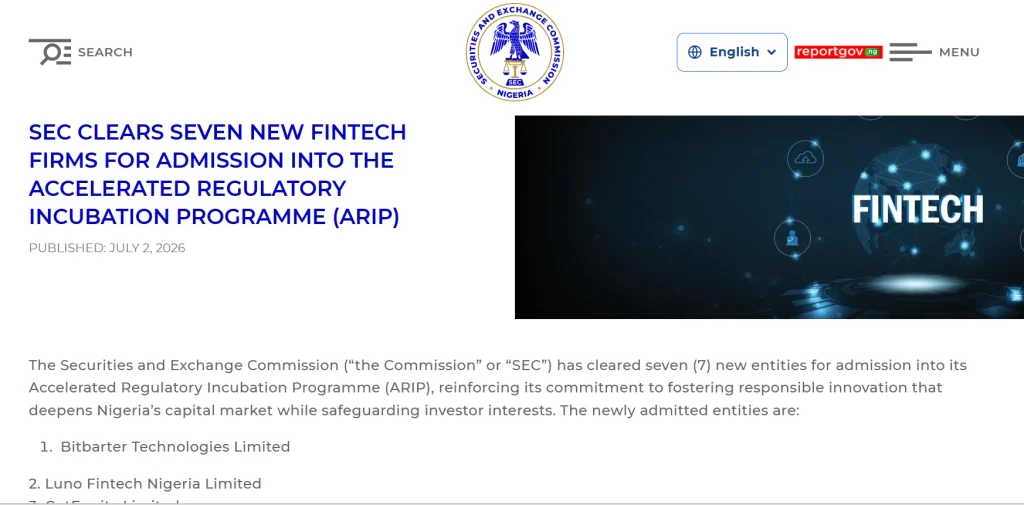
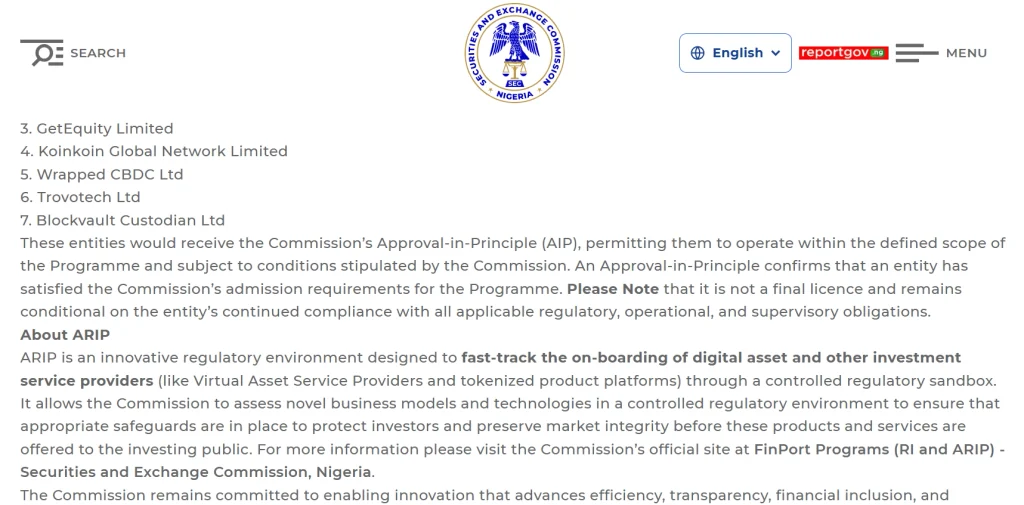
The legal framework changed afterwards with the Investments and Securities Act (ISA) 2025 bringing virtual and digital asset exchanges, and virtual asset service providers under SEC registration and regulation. Binance was not recognised or included in the July 2026 SEC circulars that admitted additional firms to its Accelerated Regulatory Incubation Programme (ARIP).
Furthermore, the SEC noted that an Approval-in-Principle is conditional on continued compliance, which means the ARIP admission is not the same as a final licence. It is also important to separate Binance’s naira decision from the court proceedings. Binance announced the end of its naira services in 2024. The tax, money laundering, and civil proceedings involve separate allegations and claims. This should not be concluded as Binance being guilty of the allegations unless a court has pronounced them as such.
The CBN’s December 2023 guidelines now allow banks to provide accounts to virtual asset service providers under specified conditions, while prohibiting banks from holding or trading virtual currencies on their own account. This was against the 2021 restrictions on banks’ ability to directly serve crypto businesses.
Now, the practical answer is therefore more precise than a simple yes or no. Binance ended its naira services, but the SEC only issued warnings about its regulatory status.
Where do the court cases against Binance stand?
The cases have different allegations and court procedures. The most recent reports did not make any final determinations on all issues. It would not be accurate to state that all the tax cases didn’t go beyond 2025, since there have been court developments in 2026.
The EFCC case
The case of the EFCC is under reference FHC/ABJ/CR/138/2024, alleging Binance Holdings Limited and Anjarwalla. The revised six-count charges involved money laundering with a total amount of $35.4 million, operating a financial institution without a licence, and dealing in foreign exchange without authorisation.
Justice Emeka Nwite of the Federal High Court in Abuja presided over the case, and the trial dates were 24th Feb 2025 and 25th Feb 2025. The federal government on 23 October 2024, on health grounds, dropped charges against Gambaryan in the EFCC case. However, the action against Binance was not abandoned. As of 28 October 2026, we were unable to find a report that clearly established a final judgment in the EFCC case.
The tax evasion case
The Federal Inland Revenue Service, now the Nigeria Revenue Service, brought the tax case against Binance. The allegations included failure to collect and remit VAT and company income tax and failure to file returns, among other counts.
On 14 June 2024, the court dismissed the charges against Gambaryan and Anjarwalla due to the amendment made to the charge by the prosecution. The charge now names Binance as the sole defendant. The Nigerian representative for Binance pleaded not guilty on behalf of the company.
This case has more recent developments than the other issues discussed. BusinessDay reported that the court adjourned the case on 12 May 2026 till 9 July 2026, while settlement discussions continued. The court adjourned it again on 9 July 2026 till 24 September 2026, for either a settlement or continuation of trial.
As at 28 October 2026, we found no report confirming the outcome of the 24 September hearing. The Federal High Court in Abuja did not host active trial arguments or issue a final ruling. Instead, the legal teams for both the Federal Government and Binance used the window to continue administrative review and reconciliation efforts.
The civil suit
The separate civil suit, identified as FHC/ABJ/CS/1444/2024, seeks compensation for alleged economic losses and unpaid tax. The Federal Inland Revenue Service sought $79,514,055,594.40 and ₦231 million for alleged economic losses, as well as $2,001,000,000 in tax for 2022 and 2023.
The case came before the Federal High Court in Abuja. In April 2025, reporting said Binance had challenged an order allowing court documents to be served by email and that the service had filed a response. A hearing was scheduled for 12 May 2025.
We found no later report clearly confirming a ruling or settlement in this civil suit as of 28 October 2026. This is a limit of the court reporting we found, not proof that nothing happened.
What we could not confirm: We found a subsequent report on the tax case, including a hearing scheduled for 24 September 2026, but no follow-up report confirming its outcome. We also found no later report establishing a final ruling or settlement in the separate EFCC case or civil suit by 28 October 2026. An absence of a report doesn’t mean a case has ended.
What can you use instead of Binance in Nigeria?
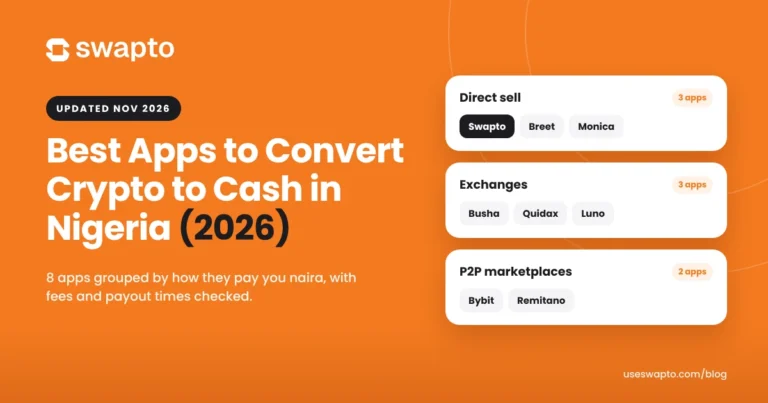
As we said at the top, Swapto publishes this guide and is one of the options below. There are different methods to convert your crypto to Naira. An exchange may offer its own conversion or withdrawal service. There is also the P2P marketplace, which can match users who trade with each other. Thirdly, there are direct-sell apps that buy crypto from the user and pay naira straight into their Nigerian banks.
How we compared
We compared using three factors. First is whether users in Nigeria can get naira into their bank accounts, how the platform describes its regulatory status, and lastly is the type of service it offers. We used the SEC’s words where available and declared the company’s statements as claims of the company. Each entry includes a limitation to consider and is grouped by type, while we listed them alphabetically in each group. The order is not a ranking.
Group A: Exchanges
The SEC says an Approval-in-Principle is not a final licence and remains conditional on the entity’s continued compliance. For more options, see our guide to crypto exchanges available in Nigeria.
Busha
Type: Crypto exchange.
For its Naira route, Busha says users can sell crypto and get credited directly in a bank account or mobile wallet. Busha’s deposit and withdrawal fees for its Nigerian users are NGN150 and NGN107.50 (7.5% VAT inclusive), respectively. Busha describes itself as an “SEC-licensed digital asset exchange”.
Checked: 28 October 2026
Luno
Type: Crypto exchange.
Luno’s Naira route provides direct fiat channels for Nigerian users to hold, deposit, and withdraw funds directly to and from their accounts. Its Nigeria fees and limits page distinguishes between instant selling and orders placed on the Luno Exchange. For their regulatory claim, Luno’s licences page states that Luno Fintech Nigeria Limited has Approval-in-Principle from the SEC for admission into ARIP. The SEC’s July 2026 circular also names Luno Fintech Nigeria Limited. An Approval-in-Principle is not a final licence. Also, Luno claims that there is a selling cost of 2% for instant selling from the Portfolio screen, and a bank transfer deposits and withdrawal flat fee of ₦150 and ₦300 respectively (excluding VAT).
Quidax
Type: Crypto exchange
Quidax’s Naira route offers a “Convert USDT to Naira” service. Its current official naira withdrawal route is the direct bank transfer (DBT). Quidax says it holds a provisional Digital Assets Exchange licence from Nigeria’s SEC. Something you should be mindful of is Quidax saying its P2P trading is no longer available on its platform. Its conversion feature is not the same as P2P trading. Quidax Naira deposit is free (you’re only charged by your bank), however you’re charged a flat 0.1% maker and taker fee on its order book, with 0.07% on USDT/NGN and USDC/NGN maker orders, while its Naira withdrawals has a flat fee of ₦200, plus a ₦50 government stamp duty for amounts of ₦10,000 and above.
Checked: 28 October 2026
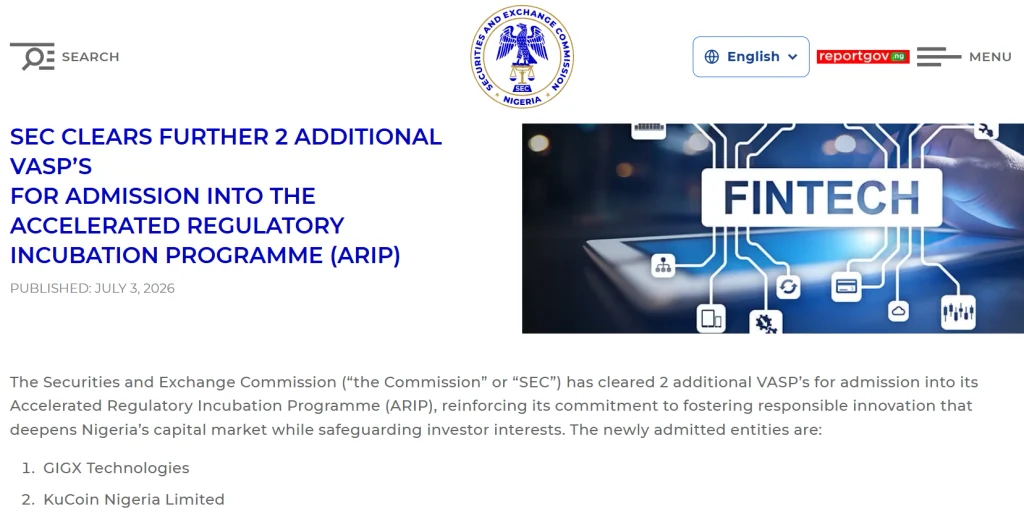
Note: KuCoin Nigeria Limited was admitted to the SEC’s Accelerated Regulatory Incubation Programme in July 2026. We could not confirm its current naira route after it paused all direct NGN P2P channels, so KuCoin is not listed here as an available naira cash-out option.
Group B: The P2P marketplaces
On a P2P marketplace, another user pays the naira while the platform provides the trading environment and may hold crypto in escrow during the transaction. Our guide explains how P2P crypto trading works in Nigeria.
Bitget
Type: P2P marketplace.
For the Naira route, Bitget’s NGN P2P offers with bank transfer were visible on 28 October 2026. As at the time we checked, Bitget is not yet named on any SEC Nigeria list or circular.
Watch out: offers and payment methods can change. Check the platform’s terms and confirm that the naira has reached your own bank account before releasing crypto.
Checked: 28 October 2026.
Bybit
Type: P2P marketplace.
Bybit NGN offers are visible when checked. We did not see an active VASP license or formal authorization from the Securities and Exchange Commission (SEC) Nigeria. Some naira payment methods have been removed from Bybit’s P2P market. Check the current available methods to know the bank or payment service suitable for you.
Checked: 28 October 2026
Group C: Direct sell apps
With a direct sell app, you sell crypto to the company and it pays naira to your bank. For more options, see our guide to apps that convert crypto to naira in Nigeria.
Breet
Type: Direct sell app.
Breet’s Bitcoin information describes selling crypto for payment to a Nigerian bank account. Breet says its Nigerian company, InBreetic Technologies Limited, has a pending application for admission to the Accelerated Regulatory Incubation Programme. Breet applies tiered transaction fees when you convert crypto to cash using its Sell feature: $0 – $999: 1.5%, $1,000 – $4,999: 1%, $5,000 and above: 0.5%. A flat ₦50 fee also applies to all Naira bank withdrawals.
Checked: 28 October 2026.
Swapto
Type: Direct sell app, not an exchange or P2P marketplace.

Regarding the Naira route, Swapto allows users to sell supported crypto in the app and withdraw naira to a Nigerian bank account. Swapto claims that Naira reaches the user’s bank in 5 to 10 minutes after a sale. There is the Auto-sell, which is an optional functionality that works in a way that, when it is turned off, users can see the Naira amount before confirming a manual sale. Swapto operates within Nigeria’s regulatory framework through a licensed partner.
Swapto currently supports BTC, USDT on TRC-20, ERC-20 and BEP-20, ETH, TRX, USDC, BNB and LTC. Coin-to-coin swaps are not live. Swapto’s support is available on WhatsApp through +234 8113372579 (9am to 9pm WAT every day) and support@useswapto.com.
Checked: 28 October 2026.
We left out platforms for which we could not confirm the necessary information from their official pages. Yellow Card has announced that it is closing its retail mobile app and that its services will focus exclusively on businesses. Read its app closure notice for the company’s explanation.
How do you move crypto off Binance and into naira safely?
If you have any cryptocurrency on Binance, please refer to the instructions of the platform you want to send to in order to get the current deposit and withdrawal information before transacting. Don’t assume the route or network you tried before would still be successful.
Check the exact network instructions of the receiving platform before sending. The network type must match at both ends. For instance, USDT sent by TRC-20 is not the same network as USDT sent by ERC-20 or BEP-20. They cannot be replaced with each other. In the end, a wrong network can result in lost funds or assets.
If you’re comfortable with the fees and the platform supports your crypto, then you can make a smaller transfer to confirm the details are correct before making a larger amount. This is to avoid loss of assets through sending to the wrong channel. Be sure to verify the total amount, network fees, and receiving address. Always verify the final amount, network fee, and receiving address carefully.
Security reminder: Never share your password, PIN, OTP, or recovery phrase with anyone who contacts you, regardless of the company they say they represent. Swapto will never ask for any of those.
For more security information, read our guides on how to avoid crypto scams in Nigeria and how to send Bitcoin to another wallet.
Tax Proceeds
From 1 January 2026, profits from selling crypto are taxable under the Nigeria Tax Act 2025 at personal income tax rates. Keep a record of what you bought as well as other details of the transaction. This is general information; contact your tax officer for professional advice.
If you need a direct sell route, you can review the available service details on Swapto’s sell crypto for naira page and check the fees and amount displayed before confirming any sale.
Frequently asked questions
Can I withdraw naira from Binance in Nigeria?
No. Binance stopped naira withdrawals on 8 March 2024, and naira was not available when we checked on 28 October 2026.
What happened to the naira left in Binance accounts?
Binance converted the naira amount left in Spot and Funding wallets to USDT after 8 March 2024, at the rate of USDT = 1,515.13 NGN, according to its notice as reported by Nairametrics.
Is Binance banned in Nigeria?
Officially, no law or order pronounced Binance banned. The SEC said in 2023 that Binance Nigeria Limited was not registered and its operations were illegal, and Binance itself ended naira services in 2024.
Does Binance P2P still work with naira?
No. Binance delisted all naira (NGN) P2P pairs on 28 February 2024, and Naira was not available when we checked on 28 October 2026.
What happened to the Binance executives detained in Nigeria?
Both were detained in late February 2024. Nadeem Anjarwalla escaped custody on 22 March 2024, according to the Office of the National Security Adviser. Tigran Gambaryan was discharged on health grounds on 23 October 2024. The EFCC case continued against Binance and Anjarwalla, as last reported in February 2025.
Is KuCoin licensed in Nigeria?
KuCoin Nigeria Limited was cleared for the SEC’s Accelerated Regulatory Incubation Programme in July 2026, and the SEC says this Approval-in-Principle “is not a final licence”.