
Last checked: 7 November 2026
Typically, a cryptocurrency to naira conversion app is either a direct-sale service, a cryptocurrency exchange, or a peer-to-peer (P2P) marketplace. The routes differ in how transactions are handled, how fees are charged, and the risks users might be exposed to. A direct-sale service brings the sale and the payout together on one platform, so a transaction usually takes fewer steps than on an exchange or a P2P marketplace. This guide covers the most important categories of services, the factors that influence their cost and timing, and the regulatory changes that are shaping Nigeria’s digital-asset market.
Swapto publishes this guide, and Swapto is one of the options in it. We judged every option, Swapto included, on the same criteria, listed under ‘How we compared these apps’.
| App | Platform type | Naira conversion / payout information | Supported crypto or features |
| Swapto | Direct sell app | Naira reaches Nigerian bank accounts within 5 to 10 minutes after a sale | BTC, USDT (TRC-20, ERC-20 and BEP-20), ETH, TRX, USDC, BNB and LTC. Optional auto-sell; bill payments from naira balance |
| Breet | Direct sell app | Says most transactions are completed within a few minutes, depending on several factors | Crypto-to-naira conversion |
| Monica | Direct sell app | Claims payouts reach Nigerian banks within 60 seconds of on-chain confirmation | Direct crypto-to-naira conversion |
| Busha | Digital asset exchange | Says users can sell crypto and receive funds directly in a bank account or mobile wallet | Crypto trading and local-currency payout |
| Quidax | Digital asset exchange | Has a USDT-to-naira conversion product | Exchange services and USDT-to-naira conversion |
| Luno | Digital asset exchange | Naira balance can be withdrawn to a linked Nigerian bank account | Exchange, instant buy and sell, NGN wallet |
| Bybit | P2P marketplace / exchange | NGN P2P trading has been available, but eight Nigerian payment methods were removed on 1 September 2026 | P2P marketplace |
| Remitano | P2P marketplace / exchange | Says users can sell to a Nigerian bank account or swap into a naira wallet and withdraw | Sell, swap and escrow-based P2P |
What are the ways to cash out crypto in Nigeria?
There are different ways to convert cryptocurrency to naira in Nigeria. The main differences are the platforms or parties involved in the transaction, how the transaction is handled, and where the naira payment comes from.
Direct-sale services
A direct-sale service offers a platform where users can sell supported cryptocurrency in exchange for a fiat-currency payment. In Nigeria, the goal is to sell the crypto and receive naira in a Nigerian bank account.
As mentioned earlier, a direct-sale app brings the sale and payment stages together under one platform, which makes the overall process simpler than using an exchange or a P2P service. However, whichever platform you choose, you should still understand the provider’s terms, supported assets, payout time, applicable charges, identity verification requirements and how to reach its official support.
Check the payout time carefully too. A platform may describe its payout time as the time it takes to pay your bank after it confirms your crypto, instead of the total time from when you send your crypto to when you get paid.
Cryptocurrency exchanges
Cryptocurrency exchanges are platforms that let users buy, sell, hold or exchange supported digital assets (such as Bitcoin or Ethereum).
Do not assume an exchange offers a direct naira payout. Some platforms provide cryptocurrency trading but may not offer withdrawals to Nigerian bank accounts. This is important when assessing exchanges in Nigeria. The fact that a market exists for an asset does not automatically mean naira withdrawals are supported.
Peer-to-peer marketplaces
A P2P marketplace is a platform that connects people who want to trade digital assets with one another. On a direct-sell platform, the platform itself buys your crypto. In a P2P transaction, you trade with another user, called a counterparty.
These marketplaces usually offer escrow. Escrow holds an asset until both parties have met agreed conditions. It can lower the risk of a trade, but it cannot make every transaction safe, nor guarantee that disputes will be settled in your favour.
There are also counterparty issues to consider in P2P. The marketplace’s dispute process and the payment method involved can both affect your experience.
Cryptocurrency cards
A crypto card is a payment card issued by a financial institution or crypto platform that lets you spend your digital assets (like Bitcoin, Ethereum or stablecoins) or earn cryptocurrency rewards on everyday purchases. They look and work like traditional debit or credit cards and can be used wherever their card network, such as Visa or Mastercard, is accepted.
A card may be useful for some payments, but its availability, supported countries, fees and restrictions depend on the provider. It should not be treated as a Nigerian bank withdrawal option unless the provider confirms that function.
How we compared these apps
A good comparison is more than a list of company names and payout times. Services should be assessed using consistent information, with the date it was checked. The following are important when evaluating a crypto-related service:
- Service type: Whether the company is a direct-sale service, an exchange, a P2P marketplace or a card-based service.
- Supported assets: The cryptocurrencies the provider supports. Network availability matters as well, because a cryptocurrency may exist on more than one blockchain network.
- Naira payment availability: Does the provider currently state that it pays out in naira? If so, does its documentation name Nigerian bank accounts as a supported destination?
- Payout timing: What does the provider actually mean by its stated payout time? A time measured after a sale has been completed is not the same as the total time from the start of a transaction to the bank payment.
- Fees and exchange rates: Whether the company publishes its charges, and whether the final amount is clear before a customer confirms.
- Identity verification: What identity checks does the provider say it requires? Verification requirements vary by service.
- Regulatory information: What does the company say about its regulatory position? Many users see a platform recognised by the appropriate regulator as more reliable than one that is not.
- Customer support: Are official support channels and operating hours published? Is there a documented complaint process?
- Service limitations: Are there restrictions on supported assets, countries, account features or payment methods?
A comparison should only include information that can be supported by a current company source, an official regulatory publication or a dated record of a genuine test.
Which apps convert crypto to naira today?
There are different types of apps for Nigerians who want to convert crypto to naira. Some are built for direct crypto sales, some are exchanges with naira withdrawals, and others are peer-to-peer (P2P) marketplaces where users deal with one another. The comparison below is based on the information we found on each app’s official website. The apps are grouped by the kind of service they provide, not ranked.
Direct sell apps
Unlike a conventional exchange with many other features, direct-sell platforms focus on converting cryptocurrency into local currency. Popular direct-sell apps include:
1. Swapto
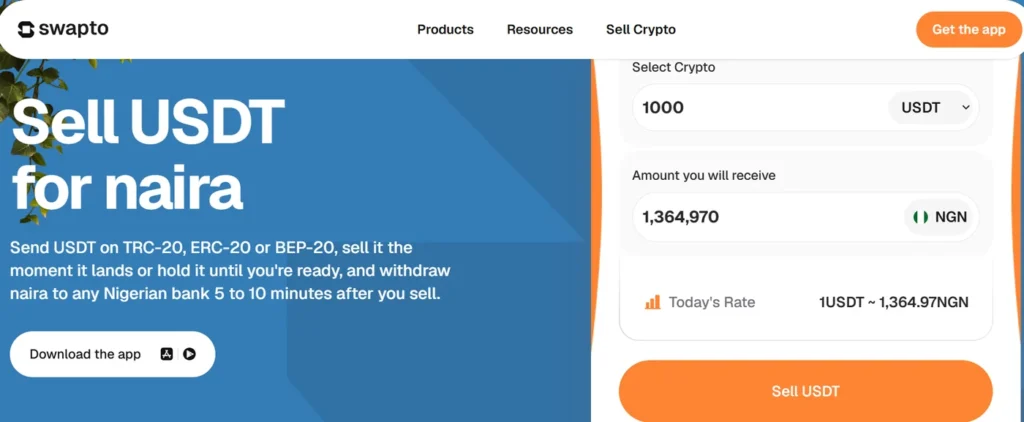
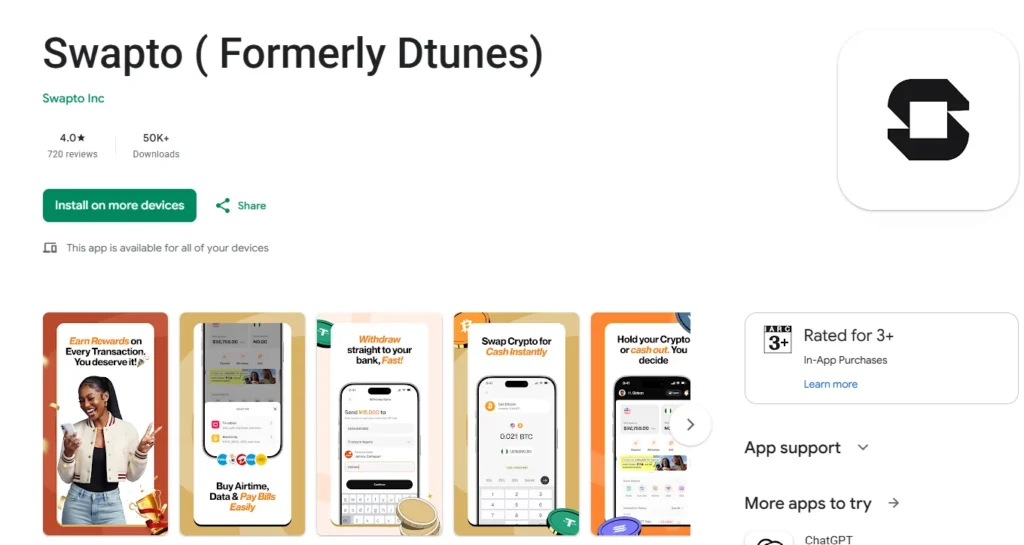
Swapto, formerly known as Dtunes, is a service for converting supported cryptocurrencies into naira. The company says naira payouts reach Nigerian bank accounts within 5 to 10 minutes after a sale. Supported assets are Bitcoin (BTC), Tether (USDT) on TRC-20, ERC-20 and BEP-20, Ethereum (ETH), Tron (TRX), USD Coin (USDC), BNB and Litecoin (LTC). Swapto also offers an optional auto-sell feature. When auto-sell is on, deposited crypto is automatically converted at the live rate after the deposit lands. When it is off, the crypto stays in your account until you sell it manually.
Swapto also supports bill payments from a naira balance, including airtime, data, electricity and cable TV. The bills are paid from the naira balance after conversion, not directly from cryptocurrency. The company’s regulatory statement says: “Swapto operates within Nigeria’s regulatory framework through a licensed partner.”
Pros
- Supports multiple cryptocurrencies and networks: BTC, USDT (TRC-20, ERC-20 and BEP-20), ETH, TRX, USDC, BNB and LTC.
- Defined bank payout timeframe: Swapto states that naira reaches Nigerian bank accounts within 5 to 10 minutes after a sale.
- Everyday payment features: Its naira balance covers airtime, data, electricity and cable TV payments. It also offers optional auto-sell.
Cons
- It is not a full trading exchange: Its main focus is selling cryptocurrency for naira, not a conventional exchange with order-book trading. You also cannot buy crypto on Swapto.
- No separate published fee schedule: Swapto shows the final naira amount before you confirm, but it does not publish a fee table you can compare line by line with other apps.
- A narrower asset range than some larger exchanges: Swapto supports seven assets, fewer than the 50 assets Quidax lists, for example.
What users say about Swapto
2. Breet
Breet describes itself as a crypto platform that converts crypto into naira. It also lists buying stablecoins and crypto-to-crypto swaps among its features. For Nigerians, the relevant service is its direct crypto-to-naira conversion. Breet says most transactions are completed within a few minutes, although it notes that the time depends on several factors. These are company claims, not a guarantee that every transaction will take the same amount of time.
Users need a Nigerian bank account, or an eligible mobile-money account, to receive fiat payments on Breet. On regulation, InBreetic Technologies Limited has a pending application for the SEC’s Accelerated Regulatory Incubation Program (ARIP). A pending application should not be treated as a final SEC licence.
Pros
- Breet supports multiple cryptocurrencies: Breet’s help centre lists Bitcoin, Ethereum, USDT, USDC, Solana, XRP, Litecoin, TRON, BNB and other supported assets.
- Its transaction fees are published: Its stated sell fee is tiered: 1.5% below $1,000, 1% between $1,000 and $4,999, and 0.5% from $5,000.
- Automatic bank settlement: Breet settles to your bank account automatically after a successful transaction. It also supports a USD balance option.
Cons
- It is not a crypto storage wallet: Breet says its receiving wallet is designed for selling, and deposited crypto is automatically converted after the required confirmations and checks.
- The fee is not zero: Its published sell fee can reach 1.5%, depending on transaction value.
- Transfers can be irreversible: Breet states that cryptocurrency sent to an incorrect address or network cannot be refunded.
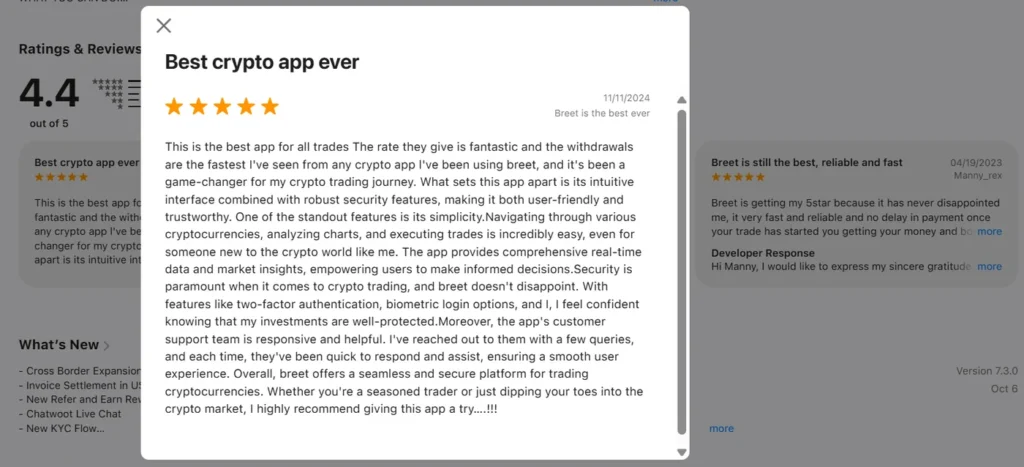
What users say about Breet
3. Monica
Monica describes itself as a crypto-to-naira off-ramp. It distinguishes this from a conventional exchange and says it is not a bank. It states that naira accounts, transfers and payouts are handled by banking partners, while crypto deposits and conversions are handled by licensed crypto exchanges. Its published claim is that payouts can arrive within 60 seconds of on-chain confirmation. That timing refers to the period after network confirmation, not necessarily the entire time from the start of a transaction.
Monica also advertises zero conversion fees. However, a zero-fee statement does not, by itself, mean a service offers the best exchange rate. Monica says its rate is set when the network confirms the deposit. The company describes its approach as aligned with the SEC’s Virtual Asset Service Provider framework.
Pros
- Zero conversion and bank withdrawal fees: Monica’s published terms state that it charges 0% for conversion and bank withdrawals.
- Supports several major cryptocurrencies: Its published list includes BTC, ETH, SOL, TRX, BNB, USDT and USDC, across specified networks.
- Additional naira-balance features: Monica supports bill payments, airtime, data and digital gift cards.
Cons
- Bitcoin deposits carry a separate charge: Monica’s terms specify a flat $2 Bitcoin deposit fee, even though several other supported assets have free deposits.
- It is not a full cryptocurrency exchange: Monica describes itself as a one-way crypto-to-naira off-ramp rather than a platform for general crypto trading.
- Its service has eligibility requirements: Its terms require users to be at least 18, ordinarily resident in Nigeria and to complete identity verification.
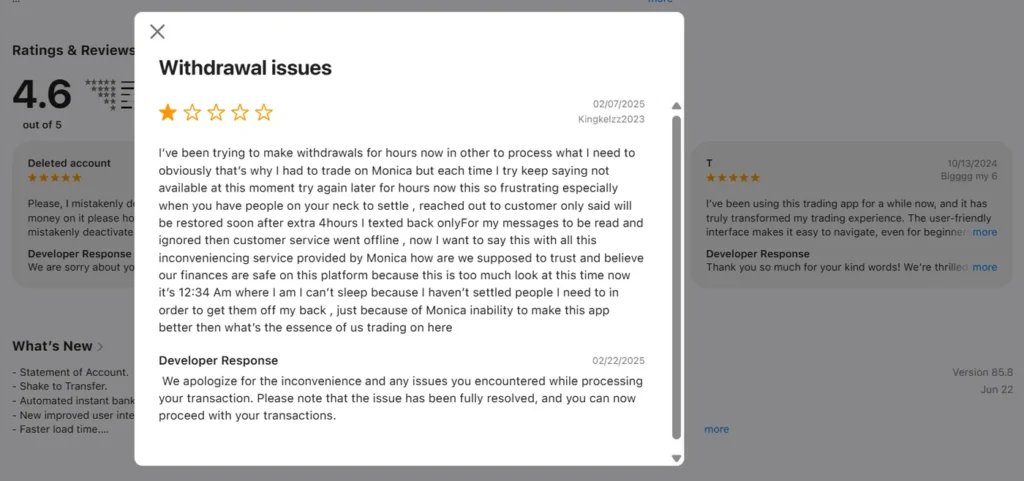
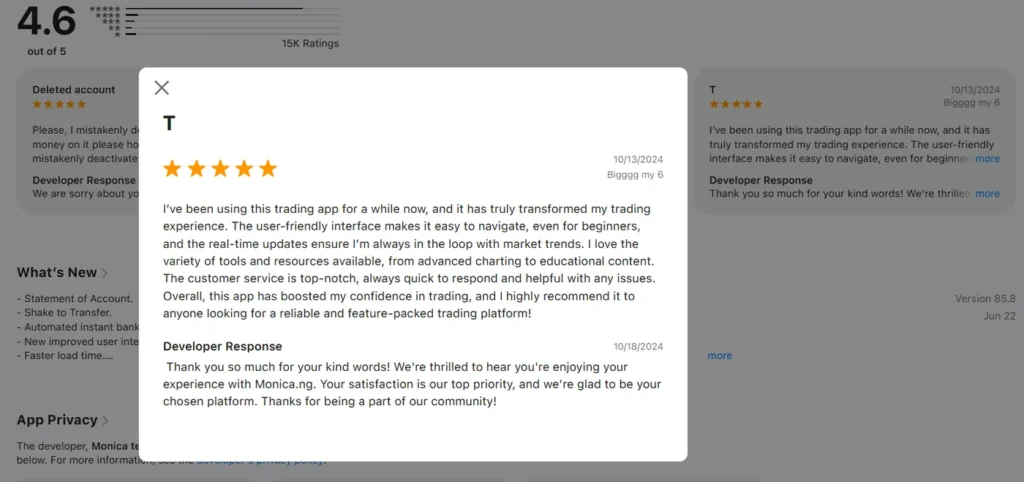
What users say about Monica
Exchanges that pay naira to your bank
An exchange generally offers a wider environment for buying, selling, holding or trading digital assets. However, being able to trade a cryptocurrency on an exchange does not automatically mean a Nigerian user can withdraw naira directly to a local bank account. The payout route needs to be confirmed separately.
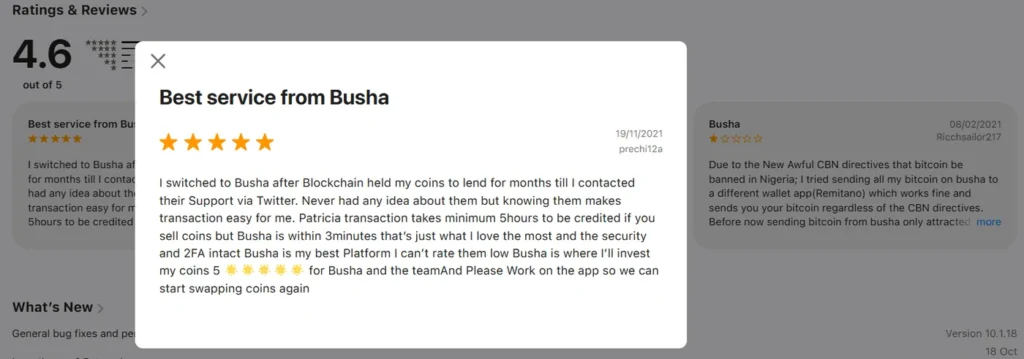
1. Busha
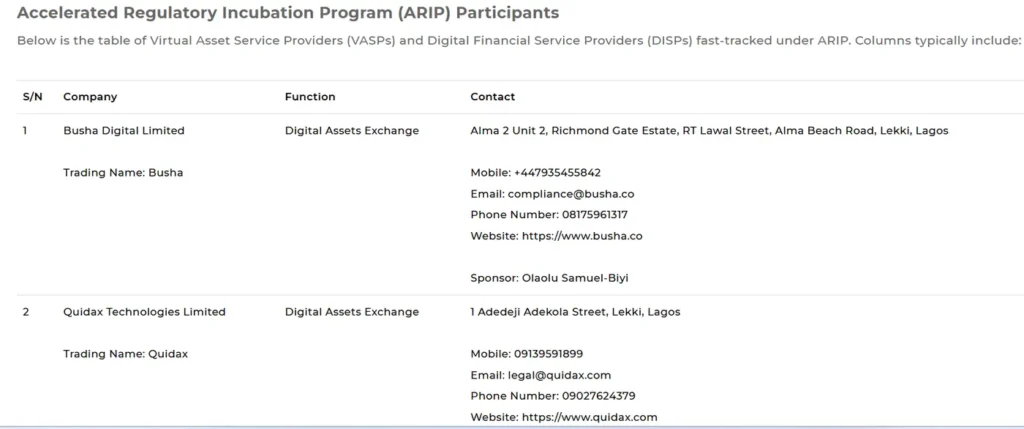
Busha describes itself as a digital asset exchange and says users can sell cryptocurrency and receive the proceeds directly in a bank account or mobile wallet. The SEC’s current Registered FinTech Operators page lists Busha Digital Limited (trading as Busha) as a Digital Assets Exchange under the Accelerated Regulatory Incubation Program (ARIP). ARIP participation is a regulatory programme status and should not be treated as equivalent to a final operating licence.
Pros
- Listed by the SEC as an ARIP participant: Busha Digital Limited appears on the SEC’s Registered FinTech Operators page as a Digital Assets Exchange under the Accelerated Regulatory Incubation Program.
- Supports both cryptocurrency and naira transactions: Its help centre documents fiat and cryptocurrency deposits and withdrawals according to user verification level.
- Has different account verification levels: Its published structure sets different transaction limits for each verification level.
Cons
- Level 1 accounts cannot withdraw: Busha’s published limits state that Level 1 accounts have no cryptocurrency or fiat withdrawal privileges.
- Higher transaction limits require higher verification: Level 2 and Level 3 accounts have different monthly withdrawal limits.
- Some trading-cost information is unclear: We could not find a complete, current retail trading-fee and spread schedule.
What users say about Busha
2. Quidax
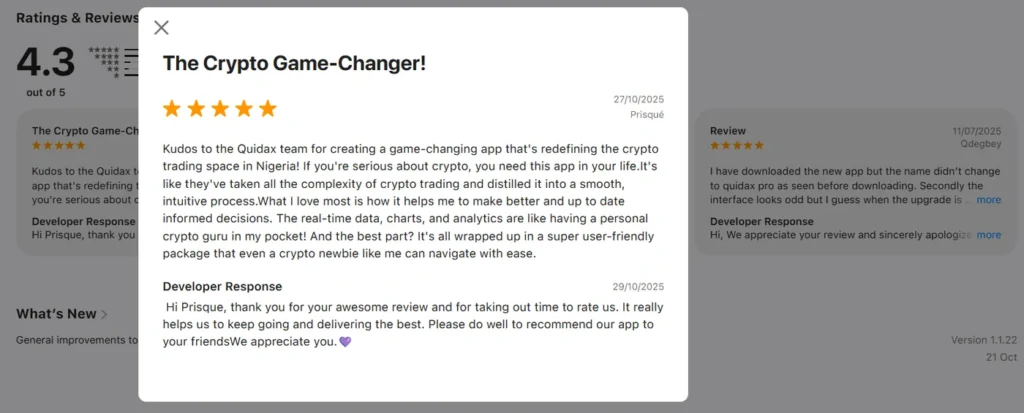
Quidax is another Nigerian digital asset exchange. Its website has a product page for converting USDT to naira. The SEC’s Registered FinTech Operators page lists Quidax Technologies Limited, trading as Quidax, as a Digital Assets Exchange under ARIP. This means ARIP participation, not full SEC licensing.
Quidax also discontinued its P2P marketplace on 23 January 2026. Its other exchange services did not stop. So Quidax’s exchange and conversion features should not be mistaken for a P2P marketplace.
Pros
- Broad cryptocurrency options: Quidax lists 50 supported assets, including Bitcoin, Ethereum, USDT, USDC, Solana and several others.
- Published trading fees: Its help centre lists maker and taker fees of 0.1% for standard trading, with a 0.07% maker fee for USDT/NGN and USDC/NGN pairs.
- Published naira withdrawal charges: Quidax documents a ₦200 direct bank-transfer withdrawal fee and a ₦50 stamp duty for transactions of ₦10,000 and above. Its SEC listing also identifies it as an ARIP participant.
Cons
- Bank withdrawals are not free: The published ₦200 withdrawal fee and applicable stamp duty add to the cost of accessing naira.
- Some cryptocurrencies are trade-only: Its supported-asset documentation separates assets that can only be traded from those that can also be sent and received.
- Its P2P marketplace has been discontinued: According to the company’s January 2026 announcement, Quidax ended its P2P service on 23 January 2026.
What users say about Quidax
3. Luno
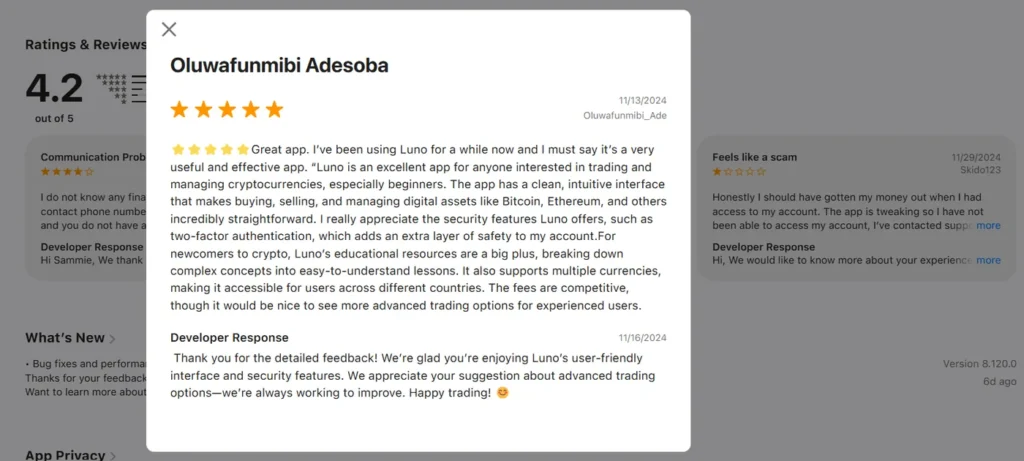
Luno is a conventional cryptocurrency exchange and custodial trading platform. It provides multi-asset crypto wallets, an internal naira (NGN) wallet, and an order-book market where users can hold assets, set trade orders, and buy or sell cryptocurrencies. Cashing out on Luno takes three stages: selling your crypto for naira in your Luno wallet, requesting a bank withdrawal, and waiting for the withdrawal to process.
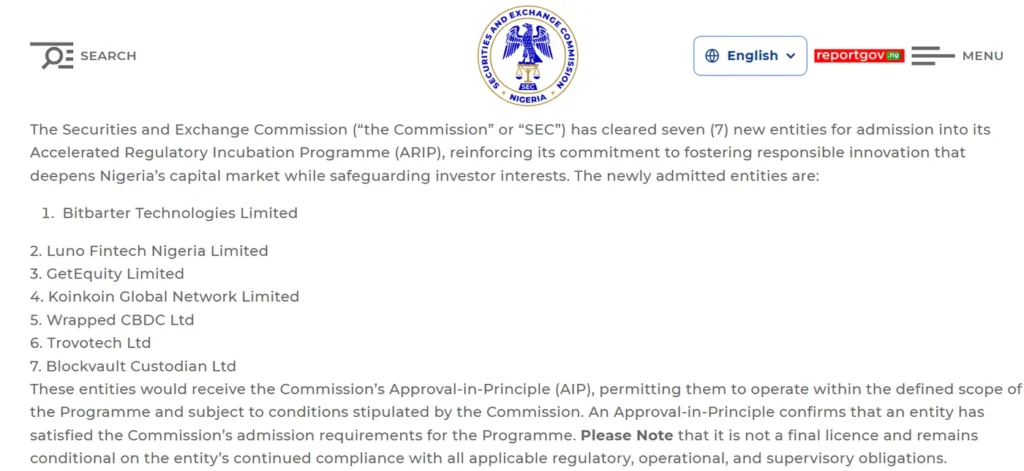
Luno handles crypto deposits and order-book conversions on its own infrastructure. For naira, Luno works with third-party payment processors to move deposits and withdrawals between your Luno NGN wallet and your linked Nigerian bank account. The SEC has also admitted Luno Fintech Nigeria Limited into ARIP with an Approval-in-Principle, which the SEC says is not a final licence.
Pros
- Direct Nigerian bank withdrawals: Luno’s help centre confirms that Nigerian customers can withdraw their local-currency balance to a linked bank account.
- A published fee structure: Its Nigerian fee schedule separates instant buying and selling costs from exchange trading fees.
- A broad range of supported assets: Its Nigerian documentation lists Bitcoin, Ethereum, USDT, USDC, Solana, XRP, Litecoin and other cryptocurrencies.
Cons
- Instant buying and selling carries a 2% transaction cost: This is the published charge for transactions through the Portfolio screen, not the Luno Exchange.
- Bank withdrawals have a provider fee: The October 2026 Nigerian fee schedule lists ₦300 excluding VAT per bank withdrawal.
- Verification affects withdrawal limits: Luno applies different limits according to account verification level.
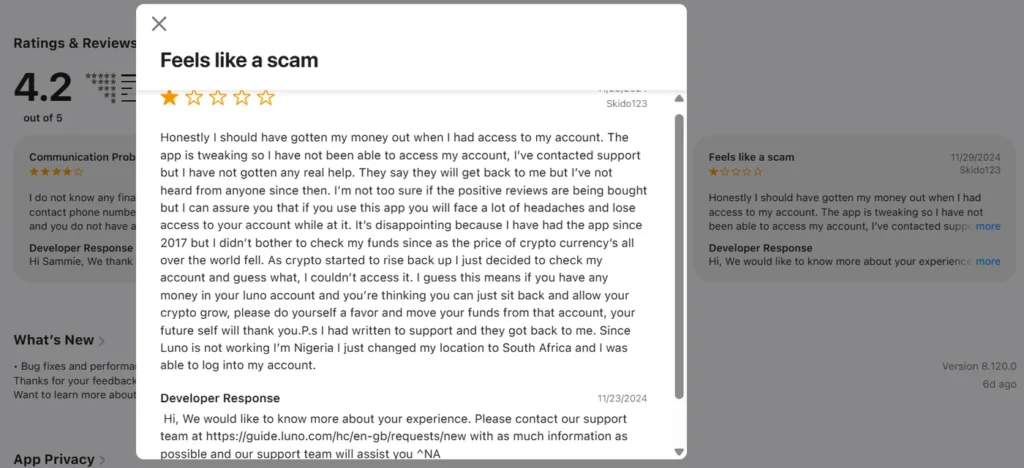
What users say about Luno
Peer-to-peer marketplaces
Peer-to-peer marketplaces connect buyers and sellers who agree on terms to trade cryptocurrency. They usually use escrow to hold the cryptocurrency during the trade. Unlike direct-sale platforms, where the service itself buys your crypto, P2P trades involve counterparties and depend on available offers and supported payment methods.
1. Bybit
Bybit operates a peer-to-peer platform that supports naira transactions. However, its settlement options have recently changed. On 1 September 2026, Bybit removed eight payment methods from its NGN P2P market: Carbon Microfinance, Chipper Cash, Ecobank, Jaiz Bank, Paga, Polaris Bank, Stanbic IBTC Bank and Union Bank. According to its notice, these methods can no longer be selected for posting NGN ads or completing trades.
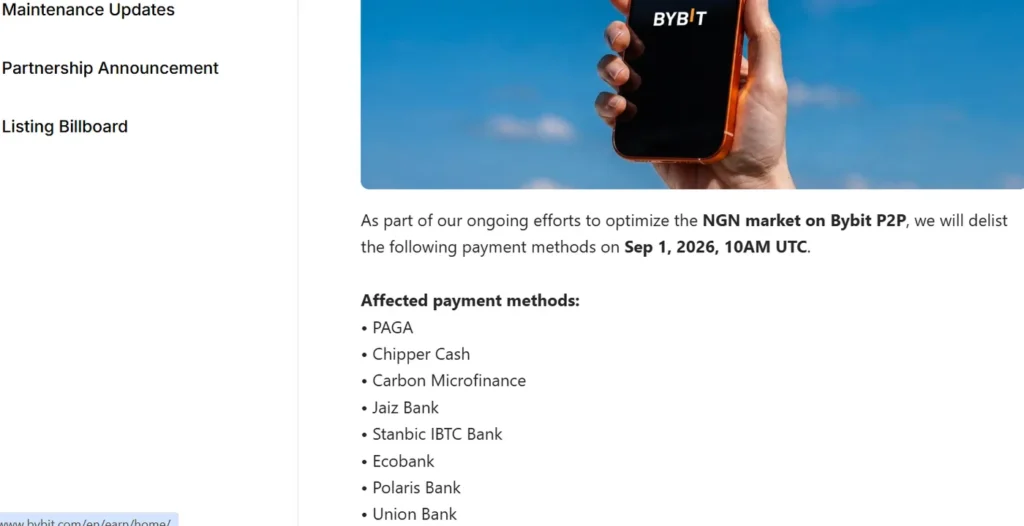
This is a restriction on specific payment methods, not a shutdown of all naira P2P trading. Then, on 6 October 2026, Bybit introduced direct NGN bank transfer options for buying USDC and USDT. That addition applies only to funding an account with naira. It should not be read as a naira bank withdrawal option when selling digital assets.
Pros
- P2P trading is available on web and mobile: Bybit confirms that its P2P marketplace can be accessed through both its website and mobile app.
- Buyers and sellers can agree on prices: Bybit explains that its P2P marketplace lets users trade at prices agreed between the two parties.
- It has a formal dispute process: Bybit publishes guidance for handling P2P payment disputes and order problems.
Cons
- Bybit does not provide the P2P offers itself: Offers come from individual advertisers, so prices and payment conditions can differ.
- Identity verification is required: Bybit’s P2P FAQ states that individual or business KYC is required to use the marketplace.
- Payment-method availability can change: The September 2026 Nigerian announcement records the removal of eight NGN P2P payment methods, which limits the payment options available.
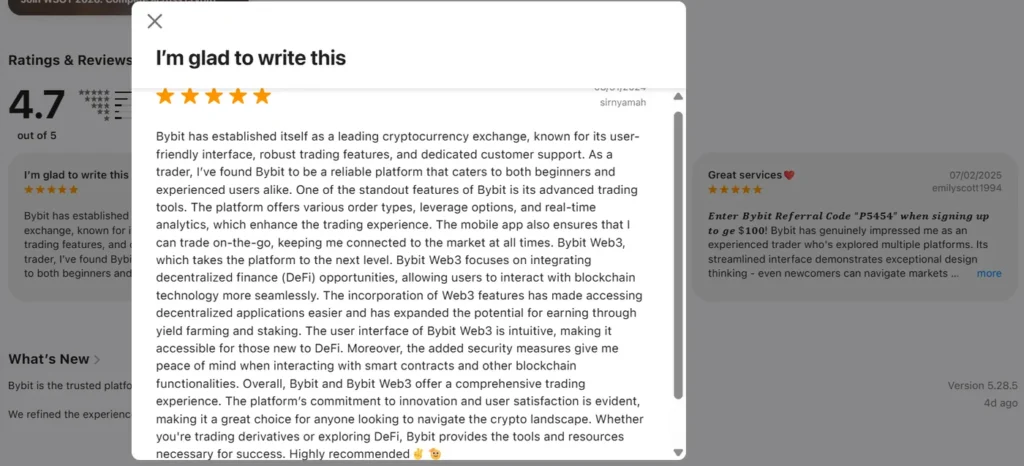
What users say about Bybit
2. Remitano
Remitano is frequently mentioned in discussions about peer-to-peer digital asset exchanges. Its Nigerian website lists three ways to cash out: selling crypto directly to a Nigerian bank account, swapping crypto into a Remitano naira wallet and withdrawing it, and escrow-protected P2P trading.
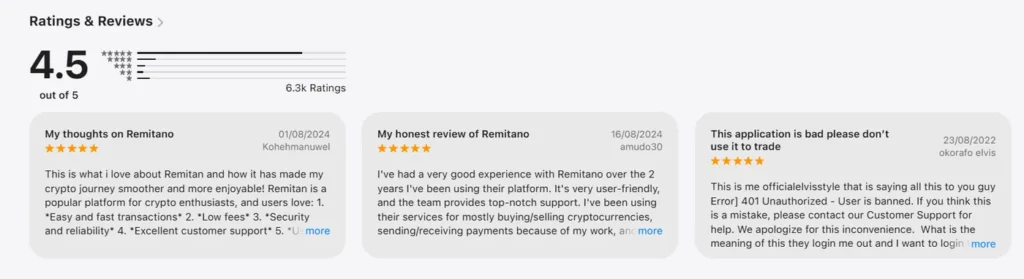
What users say about Remitano
The providers highlighted above do not offer the same functionality. Breet, Monica and Swapto are primarily direct crypto-to-naira platforms. Busha, Luno and Quidax function as digital asset exchanges. Bybit’s and Remitano’s P2P marketplaces are a separate route, and Bybit’s NGN payment methods changed in September 2026. To learn more, read our guide on how P2P crypto trading works in Nigeria.
Which apps have stopped or cut naira cash-outs?
The Nigerian cryptocurrency market has seen changes in the services offered by international and local providers. Apps that have stopped or cut naira cash-outs include:
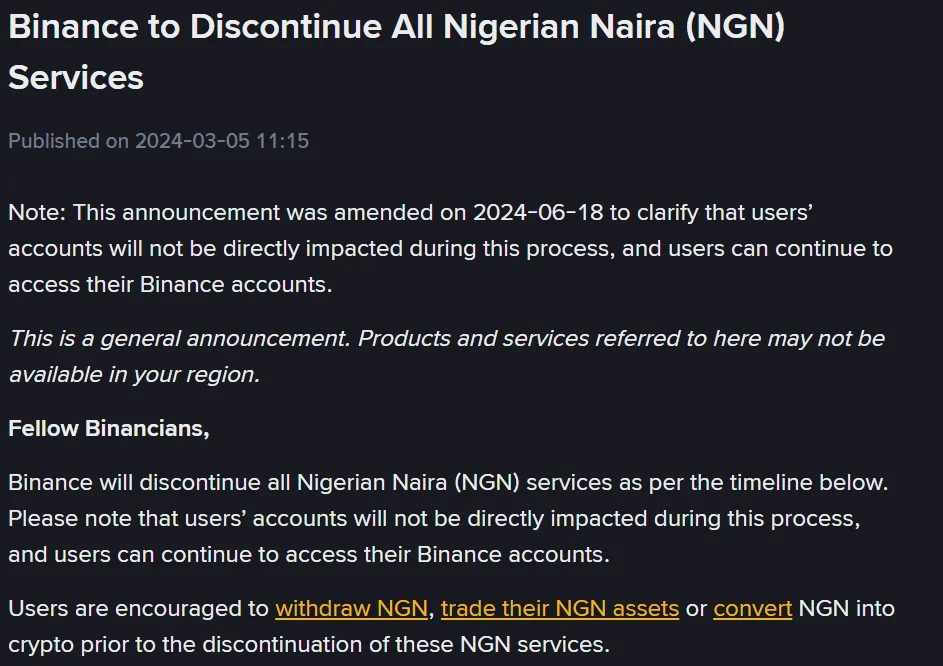
- Binance: Binance discontinued all naira services in February and March 2024 (P2P NGN pairs on 28 February, deposits after 5 March, withdrawals after 8 March). Nigerian users could keep accessing their Binance accounts.
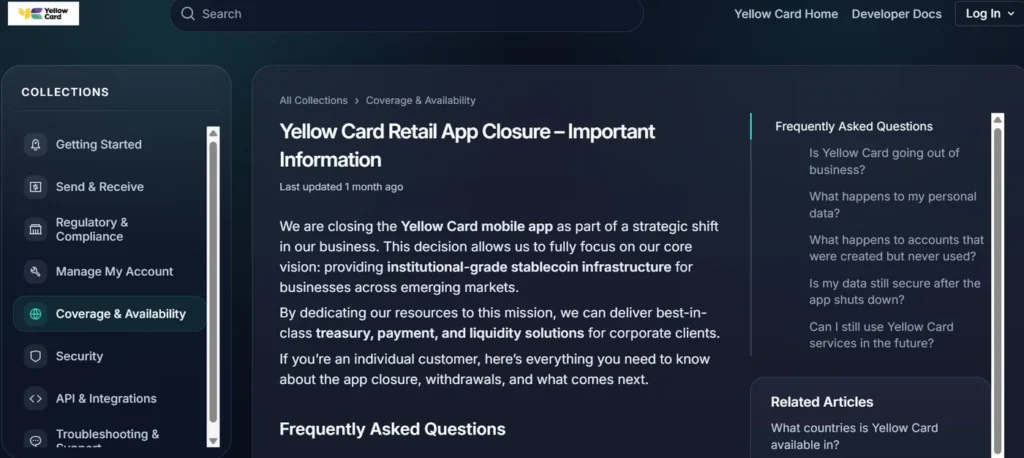
- Yellow Card: Yellow Card closed its retail mobile app on 31 December 2025 and has operated only as a business-to-business (B2B) stablecoin and payment infrastructure company since 1 January 2026.
- Bybit: Bybit removed eight Nigerian payment methods from its NGN P2P market on 1 September 2026.
- Paxful: Paxful announced it would wind down all operations by 1 November 2025.
How do you convert crypto to cash on Swapto?
Here are 5 steps to convert crypto to cash on Swapto:
- Download Swapto and create your account. Verify your identity with your BVN to trade above ₦500,000.
- Tap Deposit, choose your coin and the network, then copy your address.
- Send your coin from your wallet or exchange to the address you copied, on the same network you chose.
- To sell, turn on auto-sell to convert automatically when your crypto lands, or tap Sell and check the naira amount before you confirm.
- Withdraw to your Nigerian bank account. Your naira arrives within 5 to 10 minutes after you sell.
For more questions about the service, see the Swapto Help Center.
How long does it take to get naira in your bank?
A crypto-to-naira conversion has three stages: network confirmation, the sale itself, and the bank payout. First, the cryptocurrency network has to confirm the transfer. This timing varies by coin and network activity. For Bitcoin, for example, mempool.space shows network activity and transaction confirmations.
The second stage is the sale, and the final stage is the naira bank payout. Swapto states that naira reaches a Nigerian bank account within 5 to 10 minutes after a sale. Other providers publish different timing claims. Breet says most transactions are completed “within a few minutes, but this depends on a number of factors.” Monica claims payouts arrive within 60 seconds of on-chain confirmation. These statements are company claims, not guaranteed completion times.
What does it cost to cash out crypto?
There are three costs to know when you cash out crypto:
- The network fee charged by your sending wallet.
- The rate the app gives you when it converts your crypto.
- Any fee the platform states.
Note: A “0% fee” can come with a lower rate, so do not jump on a trade just because of a 0% fee. Work out and compare the naira you will receive in every case. On Swapto, you see the naira amount before you confirm. Network fees are charged by your sending wallet, separately.
Which option fits you?
The right platform depends on why you need it. Look at these use cases before choosing the option that fits you best:
- Paid in USDT by foreign clients? Freelancers receiving USDT need to understand how crypto payments differ from conventional international transfers. Our guide to receiving crypto from foreign clients in Nigeria explains this in more detail.
- Family abroad sending money home? Someone sending money to relatives in Nigeria may be comparing crypto transfers with conventional remittance services. See our guide to sending money to Nigeria from abroad.
- Bitcoin only? Explore our guide to the best apps to sell Bitcoin in Nigeria.
- Want to trade, not just convert crypto? A digital asset exchange offers a broader trading environment than a service focused on converting crypto into naira. Our Nigerian cryptocurrency exchanges guide explains the differences.
- Interested in P2P marketplaces? P2P platforms connect buyers and sellers directly, with marketplace rules and payment arrangements. Read our guide to P2P crypto exchanges in Nigeria.
How do you stay safe when you cash out crypto?
No platform, whether direct-sell, exchange or P2P, is completely free from risk. But you can take precautions to trade safely every time. Here are 6 tips to help you stay safe when you cash out your crypto:
- Install apps only from the official links in this guide.
- Check the network before you send. USDT on ERC-20 and USDT on BEP-20 both use addresses that start with 0x, so they are easy to mix up. Crypto sent to the wrong address or network is usually lost for good. If you are unsure, send a small test amount first to confirm the address before sending the larger amount.
- If you do send on the wrong network, contact the support team of the app you sent to immediately.
- On P2P, never release crypto before the money shows in your bank, and refuse third-party payments.
- Turn on two-factor authentication on every account you use.
- At Swapto, we will never ask for your PIN, password, OTP or recovery phrase. Avoid anyone who asks for these details. You can reach us through our official channels: WhatsApp +2348113372579 and support@useswapto.com.
Read our guide to learn more about types of crypto scams and how to stay safe when trading.
Do you pay tax when you convert crypto to naira?
From 1 January 2026, profits from selling crypto are taxable under the Nigeria Tax Act 2025 at personal income tax rates. The Nigeria Revenue Service and other relevant tax authorities provide information on tax administration. The Joint Revenue Board also published guidelines on the taxation of virtual assets in July 2026.
The tax treatment of digital-asset activity depends on the nature of the transaction and the applicable tax provisions. Keep a record of your transactions, including the date, the amount and the naira value of each sale. This is general information, not tax advice. Consult a qualified tax professional or the relevant tax authority for professional guidance.
Frequently asked questions
What is the best platform to sell crypto for cash in Nigeria?
No single app suits everyone. Each kind of platform has its strengths. A direct-sell app has the fewest steps, so payouts are usually faster. P2P lets you set a price, while exchanges let you trade or hold your crypto.
Is it legal to convert crypto to naira in Nigeria?
Yes. The CBN lifted its restriction on banks serving crypto businesses in December 2023, and the Investments and Securities Act 2025 brings virtual and digital asset exchanges and virtual asset service providers under SEC registration and regulation. Swapto operates within this framework through a licensed partner.
Can I still use Binance to cash out to naira?
No. Binance discontinued naira services in February and March 2024. Check Binance’s announcements for its current position.
How long does it take to receive naira?
Network confirmation time, plus the sale, plus the bank payout. On Swapto, naira reaches your bank 5 to 10 minutes after you sell.
Which coins can I convert to naira on Swapto?
BTC, USDT (on TRC-20, ERC-20 and BEP-20), ETH, TRX, USDC, BNB and LTC. Always use the network shown in the app.
Can I convert crypto to cash from outside Nigeria?
Yes. You can send crypto from any wallet on a supported network wherever you are, and naira will still be paid to your Nigerian bank account.
What happens if I send crypto on the wrong network?
If you send crypto on the wrong network, you will most likely lose it for good. Contact the support team of the app you sent to immediately.
What happens if a cryptocurrency service stops supporting Nigerian customers?
A provider may withdraw a particular product, payment method or country-specific service without closing its entire business. Customers should tell the difference between a discontinued Nigerian feature and a complete company closure.
Do I pay tax on crypto I convert to naira?
The Nigeria Tax Act 2025 took effect on 1 January 2026, and Nigeria’s tax framework includes provisions relevant to virtual-asset activity. The treatment of a particular transaction depends on the applicable law and your circumstances.