
If you get paid in USDT in Nigeria, there are three real ways to turn it into naira: sell it to a buyer on a P2P platform, move it through a USD account app, or sell it directly on a crypto app. The cheapest route depends on your payment size and each app’s quote at that moment. This guide shows the math at $200, $500, and $2,000.
Note: Swapto publishes this guide, and Swapto is one of the options in it. Swapto is a direct sell app: you sell your USDT to Swapto, not to another person. We describe every route on the same points: the steps, the costs you can check, the time and the risk.
Example: Adaobi, a Lagos content writer, finishes a batch of blog posts for a Berlin startup and receives $300 in USDT. She sells it on a P2P platform. The buyer pays about ₦420,000, and she releases the USDT. Three days later, the buyer’s bank reports the transfer as unauthorised. Adaobi’s bank takes the money back and restricts her account while it investigates. For two weeks she cannot pay her rent or her brother’s school fees, and the USDT is gone.
This example is made up, but every step in it is a real P2P risk, covered below. Most cash-out guides skip this part. It comes first here, because the cheapest-looking rate only counts if the naira stays in your account.
What are the ways to cash out USDT in Nigeria?
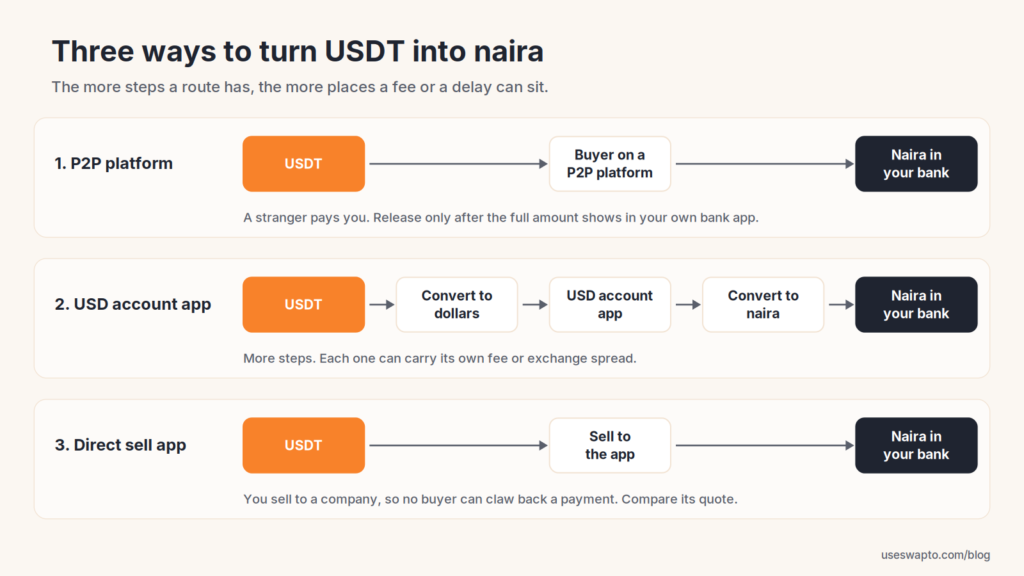
Three routes work for USDT in 2026, and each one suits a different situation.
1. Sell to a buyer on a P2P platform
On a P2P (peer-to-peer) platform, you sell USDT to another person. The platform holds your USDT in escrow, the buyer pays naira into your bank account, and you release the USDT once the money arrives.
The list of platforms has changed. Binance has had no naira P2P since 28 February 2024, and Quidax ended P2P in January 2026. On 16 October 2026, Bybit, Bitget and Remitano had naira offers. Our guide to P2P crypto exchanges in Nigeria keeps that list current.
P2P can pay a better rate, because buyers compete for your USDT. The cost is risk: you are dealing with a stranger whose money you cannot check until it lands.
2. Move it through a USD account app (such as Cleva, Raenest or Grey)
USD account apps give Nigerian freelancers US account details, so clients can pay them by ACH or wire transfer. They are built around dollars, not USDT. If you have already been paid in USDT, this route usually adds steps:
- Convert the USDT into dollars through a service that can pay into your USD account.
- Move the dollars into the app.
- Convert the dollars to naira in the app.
- Withdraw the naira to your Nigerian bank.
Each step can carry its own fee or exchange spread, and a dollar transfer can take longer than a crypto transfer. Check each app’s own page for whether it accepts USDT deposits and what each conversion costs, because both change.
3. Sell it directly on a crypto app (such as Swapto)
On a direct sell app, you send USDT from your wallet or exchange to the app, sell it to the app for naira, and withdraw to your bank. There is no buyer and no dollar step. These apps are sometimes called OTC (over-the-counter) platforms.
Because you sell to a company, no buyer can short-pay you or claw back a transfer. The trade-off is that you take the app’s rate and cannot negotiate it, so compare quotes before you sell.
Why is Wise not on this list?
Wise does not convert crypto, so it cannot take your USDT. You would have to sell the USDT somewhere else first, and by then you have already cashed out.
Still setting up how clients pay you? Start with how to receive crypto from foreign clients.
Why is P2P risky for freelancers?
P2P puts a stranger’s bank transfer between you and your naira. These are the four main risks.
- Payment reversals. The buyer pays from an account that is not theirs, or later tells their bank the transfer was unauthorised. The bank takes the money back after you have released the USDT, and your account can be restricted while it investigates. The USDT does not come back.
- Tainted funds. If the naira comes from an account linked to fraud, your account becomes part of the investigation, because it received that money. Your bank can freeze it until the case is closed.
- Fake payment alerts. Scammers send edited screenshots, SMS alerts or emails to make it look as if they have paid, then push you to release the USDT.
- Rate games. Some traders post an attractive rate, then ask you to cancel and redo the trade at a lower one, or to finish it outside the platform. Outside the platform, escrow and the appeal process cannot protect you.
Warning: Never release crypto because of a screenshot, an SMS or an email. Open your own bank app and check that the full amount has arrived. For more, read our guide on how to avoid crypto scams in Nigeria.
When does P2P still make sense?
P2P can still pay more, and it fits when three things are true:
- You trade with the same verified merchant, who has a long record of completed trades.
- You have time to wait for the payment and check it properly.
- You keep every message and payment inside the platform.
Payment size cuts both ways. A better P2P rate earns you more on a large payment, but a reversal on a large payment also costs you more. Before you choose P2P, ask whether the extra naira is worth losing access to the whole amount for weeks, as in the example above.
How much do you lose cashing out $200, $500 or $2,000 of USDT?
You pay two kinds of cost, and they behave differently as the payment grows. Fixed costs stay the same at any size, while percentage costs grow with the payment. Which route is cheaper depends on the mix.
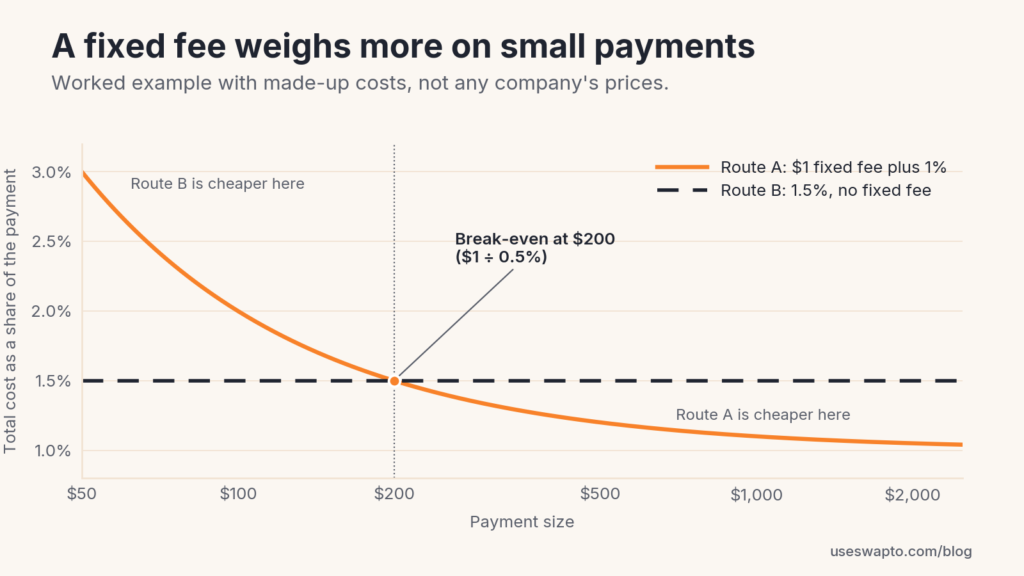
Fixed costs are charged per transaction. The network fee for sending USDT is the clearest example: it is the same whether you send $200 or $5,000. Percentage costs scale with the amount. A 1% spread or conversion fee takes ₦2,800 from $200 but ₦28,000 from $2,000, at the example rate below.
Example: two made-up routes, with costs that are not any company’s real prices. Route A charges a fixed $1 plus 1%. Route B charges 1.5%, with no fixed fee. The example rate is ₦1,400 per dollar.
| Payment | Route A pays | Route B pays | Difference |
|---|---|---|---|
| $200 | ₦275,800 | ₦275,800 | None |
| $500 | ₦691,600 | ₦689,500 | ₦2,100 more from A |
| $2,000 | ₦2,770,600 | ₦2,758,000 | ₦12,600 more from A |
At $200 the two routes pay the same. Below $200, Route B wins, because Route A’s fixed $1 weighs more on a small payment. The break-even point is the fixed fee divided by the gap between the two percentages: $1 divided by 0.5% is $200.
So no route is cheapest at every size. To find the cheapest route for your payment, compare the naira you would actually receive:
- At the same moment, open each app’s sell or convert screen for your exact amount and note the naira it shows.
- Subtract the fee your sending wallet or exchange shows for the network you will use.
- Subtract any fee for withdrawing to your bank.
- Pick the highest result from a route you trust. For P2P, use the rate a verified merchant will honour, not the top advert.
The math leaves out time and risk. A route that takes days to settle exposes you to rate changes while you wait, and a P2P reversal can cost the whole payment, not a percentage of it.
Compare now: check today’s USDT to naira rate on Swapto, then set it against your other quotes for the same amount.
How do you cash out USDT to naira on Swapto?
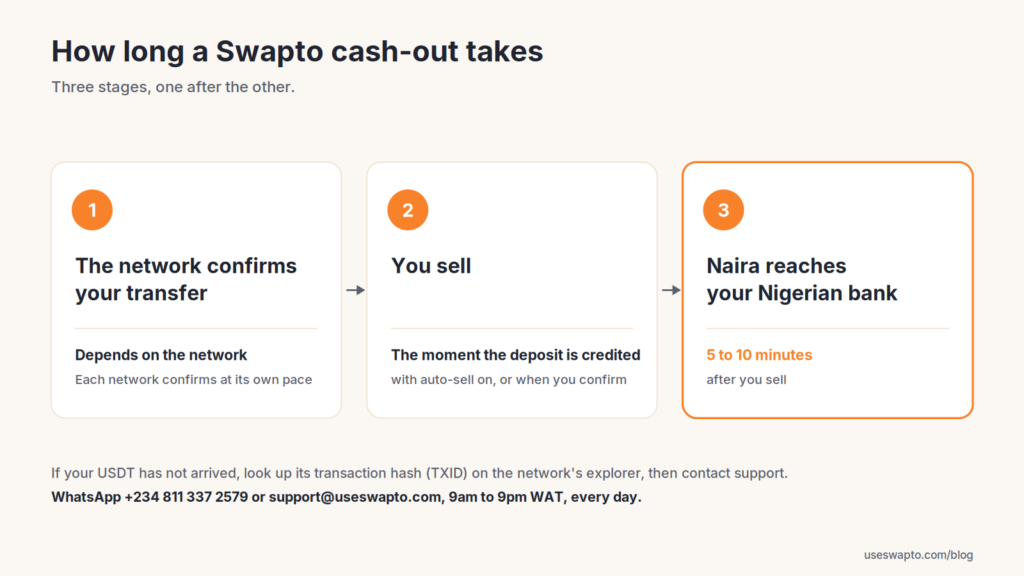
It takes five steps, and naira reaches your Nigerian bank 5 to 10 minutes after you sell.
- Verify your identity. Download Swapto and verify with your BVN. Do it before your client pays, so you are ready when the money lands.
- Get your USDT address. Start a deposit, choose USDT and the network (TRC-20, ERC-20 or BEP-20), then copy the address. Copy it from the app each time, never from an old message or your transaction history.
- Send USDT on that same network. Send from your wallet or exchange, or give your client the address and the network. Sending from your own Tron wallet? You need some TRX to pay the network fee. Exchanges usually take their withdrawal fee in USDT instead.
- Sell. With auto-sell on, your USDT converts at the live rate the moment the deposit is credited. With auto-sell off, the USDT stays in your wallet until you sell, and you see the naira amount before you confirm.
- Withdraw. Send the naira to your Nigerian bank account. It arrives 5 to 10 minutes after you sell.
The full time has three stages: the network confirming your transfer (this depends on the network), the sale (when the deposit is credited with auto-sell on, or when you confirm), and the bank payout (5 to 10 minutes after you sell).
If your USDT has not arrived, look up its transaction hash (TXID) on the network’s explorer, then contact Swapto support on WhatsApp at +234 811 337 2579 or at support@useswapto.com, 9am to 9pm WAT, every day.
Ready to sell? Sell USDT for naira on Swapto.
When is a USD account app the better choice?
A USD account app fits better in three cases:
- Your client pays in USD, not USDT. If a client can only send ACH or a wire transfer, you need US account details, not a crypto wallet.
- You want to hold dollars in an account. Swapto lets you keep USDT in your wallet until you sell, but USDT is a token issued by Tether, not a bank deposit. If you would rather hold a dollar account balance, a USD account app fits.
- You want a USD card. Some of these apps offer USD cards for online subscriptions and tools. Swapto does not offer a card.
In short
If your client pays in USD, or you need a dollar balance or card: use a USD account app.
If you have already been paid in USDT and want naira: selling directly skips the dollar step.
Paid through Upwork or Fiverr? See our guides to cashing out Upwork earnings and Fiverr crypto payments.
Which mistakes cost first-time sellers money?
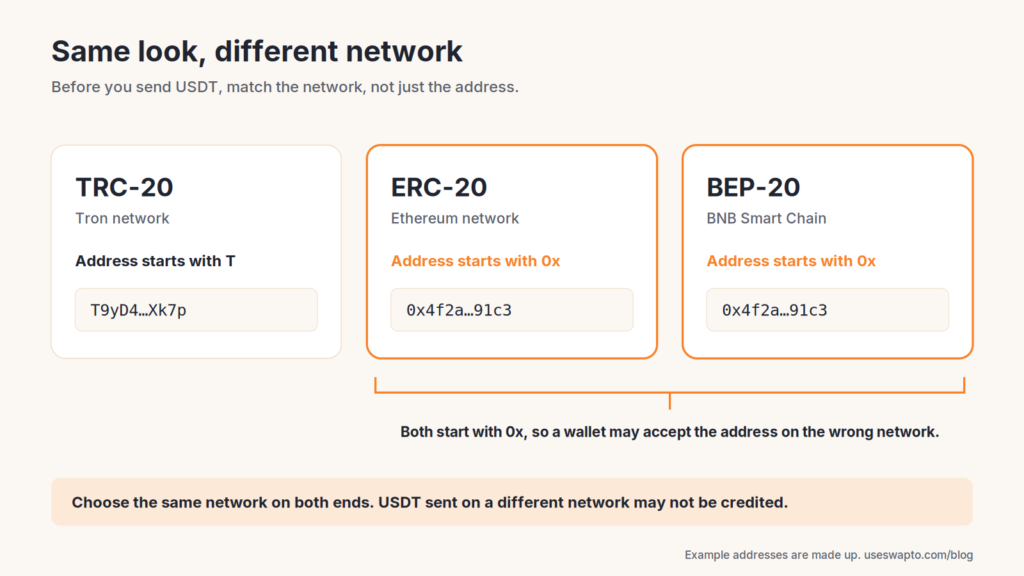
- Picking the wrong network. ERC-20 and BEP-20 addresses both start with 0x, so a wallet can accept the address even when the network is wrong. TRC-20 addresses start with T. Choose the same network on both ends, because USDT sent on a different network may not be credited.
- Skipping a test transfer. With a new client or a new address, ask for a small test payment first. It costs one extra network fee and protects the full payment.
- Copying an old address. Scammers send tiny amounts from look-alike addresses so a fake one appears in your history. This is called address poisoning. Copy your address from the app every time.
- Accepting a fake token. Anyone can create a token named “USDT”. On the explorer, check that the token is Tether USD, issued by Tether.
- Falling for an “overpayment”. A client who overpays and asks you to refund the difference to another address is running a scam. Check the TXID before you treat any payment as received.
- Releasing on P2P too early. Check your own bank app for the full amount. SMS alerts can be faked too.
- Splitting a large payment to avoid questions. Breaking a payment into pieces to get past a bank’s checks can make it look more suspicious, not less. If your bank asks about a large inflow, show your invoice, your contract and the TXID.
- Not keeping records. For each payment, log the date, the client, the invoice amount in USD, the USDT received, the network, the TXID, the naira received and the route. You will need it for tax.
Is it legal to cash out USDT in Nigeria, and do you pay tax?
Yes, it is legal, and the income is taxable.
The CBN lifted its restriction on banks serving crypto businesses in December 2023, and the Investments and Securities Act 2025 brings digital assets under SEC oversight. Not every platform has the same status, so check each one: an SEC Approval-in-Principle is not a final licence. Swapto operates within Nigeria’s regulatory framework through a licensed partner. This is general information, not legal advice.
Freelance income is personal income for tax, however your client pays you. Under the Nigeria Tax Act 2025, the first ₦800,000 of taxable income each year is taxed at 0%, and higher bands are taxed at rising rates. ₦800,000 is not a registration threshold. For individuals, your NIN serves as your Tax ID.
Tax: From 1 January 2026, profits from selling crypto are taxable under the Nigeria Tax Act 2025 at personal income tax rates. Keep a record of what you bought, when, and for how much. This is general information, not tax advice.
Frequently asked questions
What is the cheapest way to cash out USDT in Nigeria in 2026?
It depends on your payment size and on each route’s quote that day. Fixed fees weigh more on small payments, and percentage costs weigh more on large ones. For your exact amount, compare the naira each route would pay after every fee, at the same moment. If you already hold USDT, a direct sell app skips the dollar conversion step.
Do I need a USD account like Cleva if I am already paid in USDT?
Not necessarily. If your client pays USDT to a wallet you control, you can sell it for naira on a direct sell app such as Swapto without moving it into a USD account first. A USD account helps when clients pay by ACH or wire transfer, or when you want a dollar balance or a USD card.
Can I still use Binance P2P to sell USDT for naira?
No. Binance has had no naira P2P since 28 February 2024, and it ended its other naira services in March 2024. On 16 October 2026, Bybit, Bitget and Remitano had naira P2P offers. Our P2P exchange guide keeps the list current, and the risks above apply on every platform.
How long does it take to cash out USDT to a Nigerian bank account?
It happens in three stages. First, the network confirms your transfer, which takes a different time on each network. Then you sell: the moment the deposit is credited if auto-sell is on, or whenever you confirm. On Swapto, naira then reaches any Nigerian bank 5 to 10 minutes after you sell.
How do I know a USDT payment from a client is real?
Ask for the transaction hash (TXID) and look it up on the network’s explorer: Tronscan for TRC-20, Etherscan for ERC-20 and BscScan for BEP-20. Check the amount, your receiving address and that the token is Tether USD, not a look-alike. A screenshot or an email is not proof.
Which network should my client use to send me USDT?
Use a network your cash-out app accepts, and choose the same network on both ends. Swapto accepts USDT on TRC-20, ERC-20 and BEP-20. Fees differ by network and by your client’s wallet or exchange, so compare what it shows before sending. Take extra care with ERC-20 and BEP-20, because both addresses start with 0x.
Swapto or Cleva: which is better for cashing out USDT?
It depends on how you are paid. If you already hold USDT and want naira, Swapto takes fewer steps: you sell it directly, and naira reaches your bank 5 to 10 minutes after you sell. If your client pays in USD, or you want a dollar balance or a USD card, a USD account app such as Cleva fits better.
How much tax will I pay on USDT income in Nigeria?
Freelance income is taxed as personal income, however you are paid. The first ₦800,000 of taxable income each year is taxed at 0%, and rates rise in bands above that. Profits from selling crypto are taxable too. For individuals, your NIN serves as your Tax ID. This is general information, not tax advice, so ask a tax professional to work out your figure.
Which route should you use?
- Your client paid in USDT and you want naira: sell directly on a crypto app. There is no buyer and no dollar step.
- Your client pays by ACH or wire transfer: use a USD account app.
- You want a dollar balance or a USD card: use a USD account app.
- You trade with a verified merchant, have time and accept the risk: P2P can pay more.
- Whatever the route: compare the naira you would receive for your exact amount, after every fee, at the same moment.
Go back to the example at the top. Adaobi’s problem was not the rate she got. It was that the naira did not stay in her account. Choose the route where it does.
Get started: download Swapto, verify with your BVN and sell your USDT for naira.
How this guide was made: Emmanuel Tijani wrote this guide for Swapto. P2P platform status comes from our P2P exchange guide, checked on . USD account app details were checked on each app’s own pages on {date checked}. The cost table is a worked example, not any company’s prices. Swapto publishes this guide.