Last Tuesday, Tomi, a frontend developer in Lagos got the message every Nigerian freelancer hopes to see, his US client wrote “Share your USDT wallet address and the network. I’ll send the first 50% today.” To Tomi, that was a real client. The project was real, and the money was real.
The problem now is that Tomi had never actually received crypto from a foreign client before, although he had heard of USDT. He even had an old Binance account from 2021 which became dormant due to lack of consistent activity on it.
At that point, Tomi had myriads of questions running through his head. What address was he supposed to send? What exactly did “network” mean? What happens after the crypto arrives? How does he turn it into naira without getting scammed or losing money on bad exchange rates?
That is exactly why people search phrases like “how to receive crypto from foreign clients”, “verify crypto payment transaction hash”, etc. They are not looking for theory; they want to solve a situation practically. Beginners must understand that the world is changing at a very fast pace. It’s either you evolve with these changes or you get left behind and lose relevance without you knowing.
This article is for Tomi, everyone who is in a similar situation, and those who want to know how to get paid in USDT from foreign clients.
At the end of this guide, you’ll know exactly which wallet to use, which network to specify, what payment details to send your client, how to confirm the payment, how to receive USDT in Nigeria in 2026 and how to turn the crypto into naira in your Nigerian bank account. Once everything is set up, the entire process usually takes under 30 minutes. The first payment might feel intimidating, but you’ll do the third or fourth one without thinking too much.
As you proceed reading this article, download Swapto immediately to follow the instructions in this guide.
Is It Legal to Receive Crypto from a Foreign Client in Nigeria?
Yes. With the passage of the Investment and Securities Act (ISA) 2025, cryptocurrency has been legally recognized in Nigeria. The law brings digital assets and crypto-related service providers into SEC regulation. Licensed Virtual Asset Service Providers (VASPs) also operate within this framework.
Step 1: Choose Your Receiving Wallet
This is the first decision to make by anyone who wants to know how to get paid in USDT from foreign clients. The crypto enters into your wallet before you either hold or change to naira. If you’re wondering which crypto wallet for foreign payment Nigeria users should choose, it’s important to consider factors like security, supported cryptocurrencies, transaction speed, etc.
There are three types of wallets that are used by most freelancers in Nigeria.
Option A: Non-Custodial Wallets (Trust Wallet, MetaMask, Phantom)
These are wallets which are completely managed by you. It is you that get to hold your private keys, not the company. Examples of these wallets are Trust Wallet, MetaMask, and Phantom.
Advantages
- You fully control your funds.
- No one is able to freeze your wallet remotely.
- Works across many coins and blockchain networks.
- This category has better long-term flexibility.
Downsides
- If you lose your seed phrase, the money may be unrecoverable.
- There is no reliable customer support.
- It has a slightly steeper learning curve for beginners.
Best For: It is best for Developers, designers, crypto-native freelancers, and users who are getting large payments and who want maximum control. For many Nigerian freelancers, this becomes the preferred long-term setup.
Option B: Exchange Wallets (Binance, Bybit, KuCoin)
This is the wallet that is already integrated into a crypto exchange account. Binance, KuCoin, Bybit are examples of such exchanges.
Advantages
- It is easy for someone already using the exchange.
- It offers simple coin swapping.
- It can be helpful for traders who are active.
Downsides
- The wallet is under the control of the exchange.
- Access may be temporarily locked due to KYC review or restrictions.
- Withdrawal functionality may be impacted by regulatory actions.
This was something that many Nigerians were taught during the days of disruptions by Binance’s NGN-related disruptions.
Best For: Individuals who are already active crypto traders.
Option C: Nigerian Cash-Out App Wallets
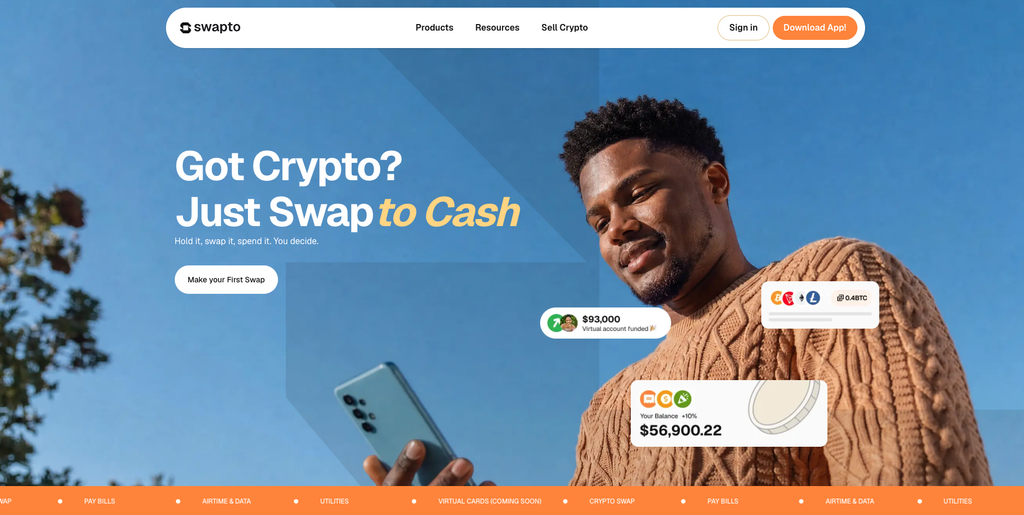
These are applications that are designed and built primarily for receiving crypto and automatically converting directly to naira. They are also known as OTC (Over-the-Counter) platforms. Here, the platform is the buyer. You send your crypto, the platform converts it, and the Naira lands in your bank automatically. An example of this is Swapto.
Advantages
- They have an extremely simple workflow.
- They are built specifically for Nigerian bank withdrawals.
- The OTC platforms are popular for a faster naira conversion experience.
- It is useful for freelancers who do not want to hold crypto long-term.
Downsides
- It has a custodial setup.
- It is not good for a long-term storage
Best For: Freelancers who want naira in their bank account as soon as possible.
Download Swapto on iOS or Android. Cash out your first trade in under 10 minutes. Support available on WhatsApp at +234 811 337 2579.
Download SwaptoThe Practical Setup Most Freelancers End Up Using
Take an instance where you want to get USDT as a Nigerian freelancer and convert the USDT to naira instantly. This is what the cleanest workflow looks like:
- Receive USDT in Trust Wallet (where you own the keys and can hold or convert any time), then verify the payment safely.
- Send the USDT to Swapto when ready to cash out.
- On Swapto, sell your USDT and get your naira in your local bank.
That setup combines the security of self-custody with the speed of a professional naira off-ramp. If you want a single-app workflow, the Swapto wallet works as both your receiving address and your instant naira cash-out, with customer crypto held by a third-party digital asset custodian and 24/7 phone support on +234-811-3372-579.
Step 2: Decide Which Crypto and Which Network
This is where most beginners get confused, but we’ll break it down for you. To send you crypto, your client needs two things; the crypto and the network
Which Crypto Should You Ask For?
The first option is to request for USDT. USDT has remained a default recommendation. For several reasons, tether has remained the standard choice for Nigerian freelancers. This is because:
- The USDT has a Stable value. 1 USDT is pegged roughly to $1 (making a 1:1 ratio)
- The USDT is greatly recognized globally as the market’s stable coin.
- It is supported almost on all platforms
So if your client says he’ll send you $500 USDT, you’ll immediately know that the value should remain close to $500 during the transfer. That stability matters a lot, you’ll see why USDT is recommended (instead of other popular coins) in this article as you read further.
The second option is to request for USDC. USDC is also good and similar to USDT. Some users prefer it for its transparency. Although in Nigeria:
- USDT generally has better liquidity
- USDT is supported by more OTC platforms
- USDT has more widespread usage
NB: Avoid BTC and ETH for Normal Freelancer Payments because Receiving payment in Bitcoin and Ethereum can cause volatility risk. Bitcoin can swing 5–10% between the time the client sends you money and the time you cash out. That swing can eat-up your project’s profit.
A client may send $500 worth of BTC and by the time you cash out, the value could have shifted noticeably. That difference means a lot when rent, internet bills, or project expenses depend on that particular income. Stablecoins reduce that frustration and that is why it is strongly advised to use USDT.
Which Network Should You Specify?
It is very important to pay close attention here. Sending crypto on the wrong network can cause you to permanently lose funds. Here is the practical breakdown:
| Network | Typical Fee | Speed | Best Use |
| TRC20 (Tron) | $1 | About 5 mins | Default Nigerian freelancer option |
| BEP20 (BSC) | $0.10–0.50 | Up to 5 mins | Binance-heavy users |
| Solana | Under $0.01 | Few minutes | Web3-native clients |
| ERC20 (Ethereum) | $1–$10+ | 10–15 mins | Large payments |
| Polygon | Under $0.10 | About 5 mins | Growing Web3 usage |
USDT TRC20 vs ERC20 for freelancers- TRC20 offers lower fees and faster transfers, while ERC20 provides a larger compatibility but usually comes with higher costs.
We recommend that Nigerian freelancers should ask for USDT on TRC20. TRC20 is currently the safest option due to its low fees, speed, compatibility, and reliability
Step 3 — Send the Wallet Address to Your Client
This is the exact point where many freelancers panic. In case you’re confused on what content to send to your client regarding details of your wallet address or how exactly to draft it out, we’ve got you covered. Below is a simple but professional guide to use as a template. No need to complicate it.
Subject: Payment Details
Hi [Client Name],
Here are my payment details for the project:
- Currency: USDT (Tether)
- Network: TRC20 (Tron)
- Wallet Address: [PASTE YOUR ADDRESS HERE]
Important: Please confirm that the network is TRC20 before sending. Sending USDT on a different network (like ERC20 OR BEP20) will not reach my wallet and may result in permanent loss of funds.
Once sent, please share the transaction hash so I can track and verify the payment. Confirmations usually take 2-5 minutes.
Thank you,
[Your Name]
Three important rules to note with the template above:
- Always specify the network clearly. Don’t assume that your client knows it.
- Always include the wrong-network warning. This will help your clients to know the difference between the right and wrong network.
- Always request the transaction hash. This is how you verify the payment is real before you do any work.
A good part of a beginner’s crypto transfer problems come from missing a single detail. Don’t give that chance.
Step 4 — Verify the Payment When It Arrives
Do not rely only on screenshots. There are digital apps that can manipulate a screenshot without causing any suspicion, this is to tell you that a screenshot cannot be completely trusted. A blockchain transaction hash is the proof that matters to you. There are three ways to safely verify payment:
1. Check Your Wallet
This is the quickest way to know your client has made payment. You do this by opening your wallet app and check your transaction history to confirm if the agreed amount has dropped in your account. For TRC20 payments, the USDT usually appears within a few minutes.
2. Verify Using Blockchain Explorers
To verify using blockchain explorers, paste the transaction hash into tronscan (for TRC20), bscscan (for BEP20), or etherscan (for ERC20). You’ll see if the transaction succeeded, the exact amount sent, and whether it landed at the right address or not.
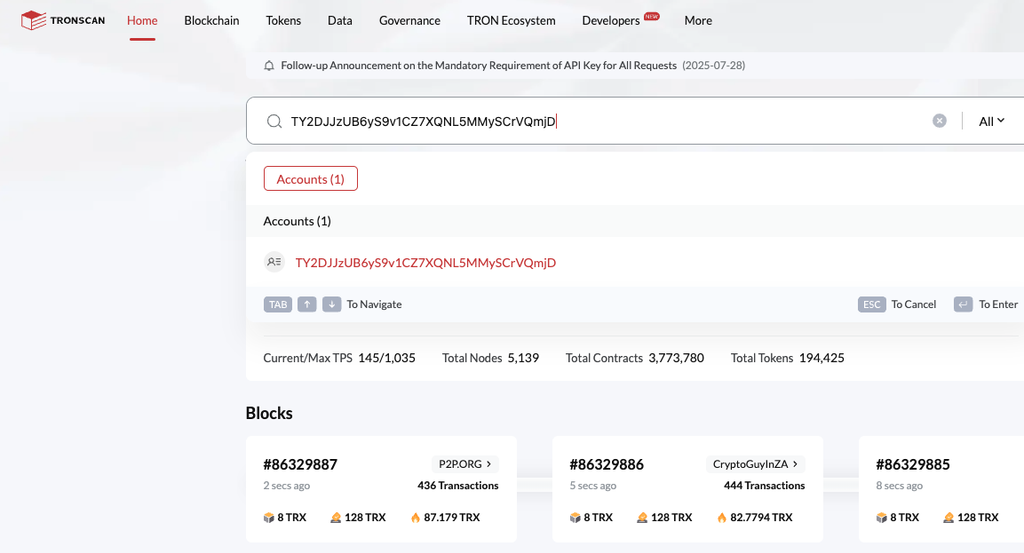
3. Wait for Confirmation
Do not rush to deliver work before confirmation. Don’t allow your client or anyone to pressure you to do this. Most networks take a few minutes to confirm.
Important Anti-Scam Rule to note
Always verify on the blockchain explorer using the transaction hash, not on a screenshot. The client may send a screenshot of a ‘transaction’ that never actually happened. If a client can’t or won’t share the transaction hash after sending, treat that as a red flag. A sender who truly made payment will always have a transaction hash.
Step 5: Convert the Crypto to Naira
I. If You Received USDT in Trust Wallet
Trust Wallet can be used for freelancer payments in Nigeria. If the sender transfers USDT to your Trust Wallet instead of directly to Swapto, you can still cash out easily by moving the funds to your Swapto wallet and converting them to naira. Follow these steps:
Once the USDT reflects in your Swapto account, you can proceed to convert it to naira instantly.
II. If you received USDT directly on Swapto
The process here is simpler, faster, and more transparent:
- Open the Swapto app and log in to your account.
- Tap “Sell USDT“ on the Swapto app. The current naira rate is shown upfront
- Enter or select the amount of USDT you want to convert.
- Review the exchange rate and naira amount displayed upfront.
- Confirm the transaction.
Your naira balance will be credited immediately after the trade is completed. Withdraw the funds directly to your Nigerian bank account (GTBank, Opay, Palmpay, Access Bank, UBA, First Bank, Zenith Bank, and others popular Nigerian banks are all supported).
In most cases, the entire process, from receiving USDT to getting naira in your bank account can be completed within 5-10 minutes, making Swapto one of the fastest and most convenient ways to convert crypto to cash in Nigeria.
The major advantage of OTC conversion (involving Swapto) is the simplicity involved, absence of buyer negotiation, absence of P2P disputes, absence of scam and the absence of anxiety that your bank account might be frozen.
The Math: What You Actually Take Home and Why Freelancers Keep Switching to Crypto Payments
Let’s use a realistic example, say $500 Client Payment
| Step | Result |
| Client sends $500 USDT | Network fee: $1 |
| Amount of USDT that arrives in your Swapto wallet | $499 equivalent |
| Sell USDT on Swapto at 1% OTC spread | $499 × ₦1,363 (current rate) = ₦680,137 |
| Swapto 0.5% Cashback | +₦3,400 |
| Withdraw to your local bank | Usually free (except for local charges) |
| Total amount received | ₦683,537 |
| Total time | Less than 20 minutes after confirmation |
With Swapto, your Final outcome is close to ₦685k depending on rates. But the same $500 routed through Payoneer would arrive as approximately ₦460k after Fiverr or Upwork fees plus Payoneer’s 4.5% chain plus 2–5 days of waiting. The direct crypto route returns about ₦223,000 more on a $500 payment, in 30 minutes instead of 5 days.
Over 12 months of $500-per-month direct payments, that’s over ₦2million in retained earnings . As a freelancer, you must know how to navigate your ways by learning how to convert upwork USDT to Naira, how to avoid crypto scams, as well as know how to take Fiverr clients off-platform safely.
Please Note: The rates used at ~₦1,331./$ mid-market as of September 17 . For better insights on the peculiarity of each platform, endeavour to check their respective website and social media pages.
Common First-Time Mistakes to Avoid
- Sharing the wrong network address: When your client tells you to send your USDT address and you send a TRC20 address but they use ERC20 instead, the money goes void. Always specify your network as boldly as possible.
- Sample transaction: This importantly reduces the chance of you or your client making a mistake in the payment process. For your first time with a new client, ask them to send a small amount ($10 or $20) as a ‘test’ before the full payment. This helps you both to learn the workflow safely.
- Trusting screenshots: Just as emphasized above, a client showing you an ordinary screenshot of a transaction is not proof. Always check the transaction hash on a blockchain explorer before proceeding to deliver your work.
- Cashing out P2P with strangers: Most P2P transactions carry real counterparty risks (such as fake payment alerts, EFCC account freezes, etc) in Nigeria. OTC platforms like Swapto remove this risk. Stay away from this method so you don’t fall victim.
- Not keeping records. The Nigeria Tax Act 2025 requires income reporting. Keep a simple spreadsheet of every client payment: date, client name, amount in USD, amount in naira, transaction hash. For easy tax payment.
What to Do If Something Goes Wrong?
The Payment Hasn’t Arrived After One Hour
Most crypto transactions are completed within a few minutes. The first step is to verify whether the transaction was successfully sent and confirmed on the blockchain. Ask the sender for the transaction hash (TXID) or transaction ID. This unique reference allows you to track the status of the transfer in real time.
Depending on the network used, you can verify the transaction on the appropriate blockchain explorer Tronscan for TRC20 (TRON) transactions, BscScan for BEP20 (BNB Smart Chain) transactions, and Etherscan for ERC20 (Ethereum) transactions
When you enter the transaction hash, check for the transaction status (successful, pending, or failed), number of confirmations received, sender and recipient wallet addresses, amount transferred and network used for the transaction
If the transaction shows as successful on the blockchain but the funds are still not visible in your wallet, contact your wallet or platform’s support team with the transaction hash for further assistance.
The Payment Was Sent on the Wrong Network
Sending cryptocurrency through the wrong network is one of the most common mistakes users make. For example, a sender may transfer USDT using the BEP20 network when the receiving platform only supports TRC20. In such cases, the funds may not appear automatically in the recipient’s wallet.
Recovery is sometimes possible if the receiving wallet provider supports the wrong network, in this case, you should contact their support for assistance. Don’t promise the client anything until you’ve checked, because funds are sometimes irrecoverable.
A few extra seconds spent confirming the correct network can prevent delays, support issues, and potentially irreversible loss of funds.
The Naira Conversion Is Lower Than Expected
Rates fluctuate hour to hour. The Swapto app rate is shown upfront, check it before initiating the sale. If you suspect a platform is giving you a poor rate, screenshot it and compare it to Monierate or two other similar apps.
Frequently Asked Questions
Is it legal to receive crypto from foreign clients in Nigeria?
Yes. Cryptocurrency is legally recognised in Nigeria under the Investment and Securities Act (ISA) 2025. The Securities and Exchange Commission regulates digital asset platforms, and the Central Bank of Nigeria reversed its 2021 banking ban in December 2023.
Which crypto is best for freelancer payments?
USDT (Tether) on the TRC20 network is the default for Nigerian freelancers. It’s pegged to $1 so the amount you receive equals the amount agreed, network fees are around $1, and confirmation takes 2–5 minutes. USDT on TRC20 because of its stability, low fees, speed and widespread support.
What wallet should I use to receive crypto from a client?
For most freelancers, Trust Wallet or MetaMask works well for receiving. Once the payment arrives, transfer it to Swapto for conversion to naira. If you want a single-app workflow, Swapto wallet can serve as your receiving address, it converts to naira in 5–10 minutes with 0.5% cashback.
How long does the full process take?
Receiving the crypto takes about 2–5 minutes on TRC20, 10–15 minutes on ERC20, seconds on Solana. Converting on Swapto takes 5–10 minutes once you initiate the sale. Total time from client clicking send to naira in your Nigerian bank account takes less than 30 minutes. This is faster than Payoneer (2–5 days) or wire transfer (3–7 days).
Do I need to be a crypto expert?
No. You only need your wallet, your correct network, your foreign client wallet address, the correct payment message and the basic verification knowledge that we’ve discussed in this article. That is enough to start safely.
The Bottom Line
Receiving crypto payments from foreign clients is one of the most important financial workflows for Nigerian freelancers, this is because it is faster than Payoneer, cheaper than Fiverr withdrawal chains, accessible globally and increasingly gaining more recognition in remote work. The first payment may seem complicated because everything is unfamiliar, but after a few successful payments, the entire workflow becomes simple.
Download Swapto on iOS or Android. Cash out your first trade in under 10 minutes. Support available on WhatsApp at +234 811 337 2579.
Download Swapto